Autumn Photography Ideas: 8 Ways to Use Fall Light
 by Marco Carotenuto · · 7 min read
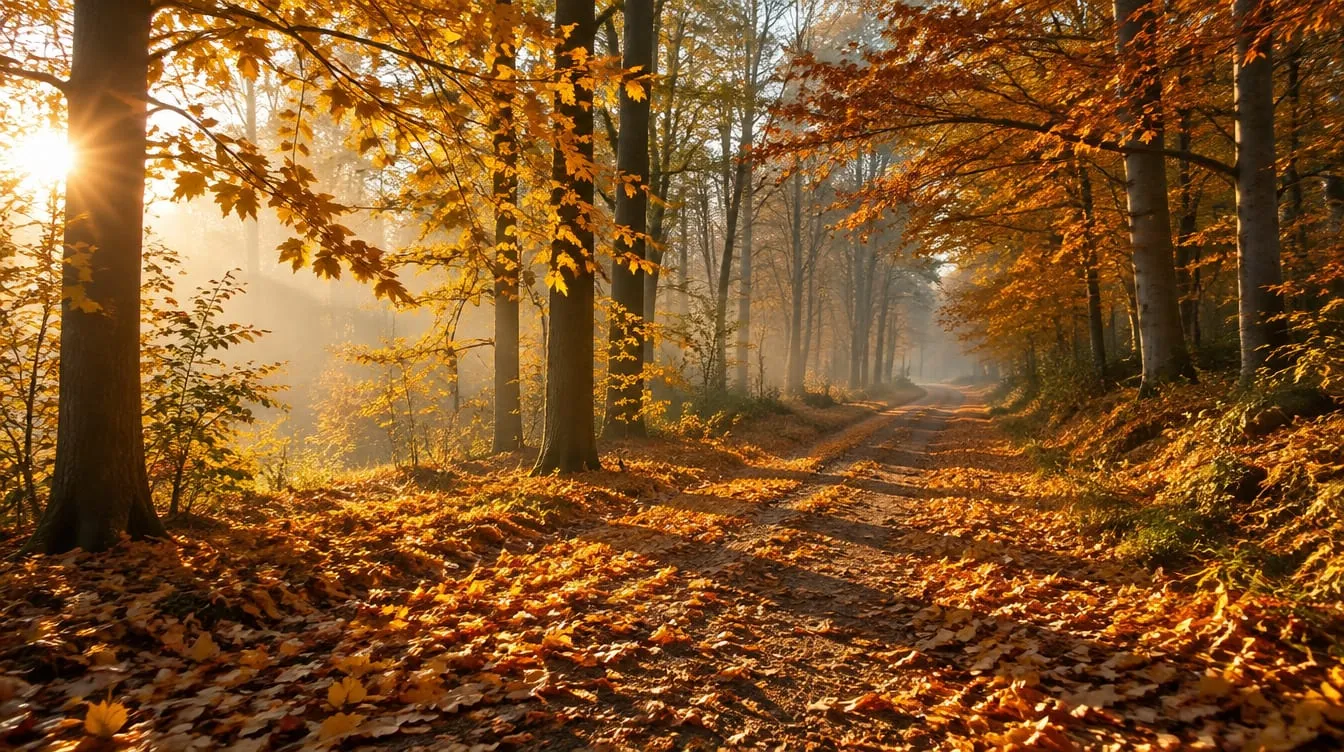
Autumn has the colors, but color alone does not make a good photo. A yellow tree under a high sun and a half-blank sky usually gives a tidy but flat picture. What separates a photo of leaves from a photo of autumn is almost always the light, not the subject.
This guide gives you eight autumn photography ideas, each tied to a light or weather condition you can recognize in a few seconds. The method is simple: step outside, look at the sky, and pick the idea that this light rewards. If you want the fundamentals first, start with how to read light in photography.
What light is best for autumn photography?
There is no single right light: it depends on the effect you want. The sources lean on two opposite situations. Landscape photographer Max Foster argues that overcast days are best for foliage, because the soft, low-contrast light makes colors look rich and cuts glare on the leaves. The School of Photography points instead to golden hour, with the sun behind or to the side of the subject, to make leaves glow.
The two claims do not contradict each other; they are two tools. Overcast gives you clean, even color all day long. Low sun gives you warmth, direction and contrast, but only for a short window. The table below helps you choose from what you see.
| What you see outside | Idea to use | Starting point |
|---|---|---|
| Even overcast sky | Rich color in the woods, details, moving water | Normal exposure, low ISO, keep the sky out of the frame |
| Low sun, clear sky | Backlit leaves, a path with long shadows | Expose for the highlights, check the histogram |
| Morning fog or haze | Layered trees, shapes emerging | Positive exposure compensation, verify with the histogram |
| Still water, little wind | Mirror reflections | Small aperture for sharpness, tripod |
| Wind | Intentional camera movement, or tighter, sheltered frames | Fast shutter, or 1/4–1 s with deliberate movement |
| Bare trees, late season | Branches in black and white, minimalism | Normal exposure, convert to B&W |
1. How do you photograph fall foliage under overcast skies?
Leave the sky out and fill the frame with woodland. When the sky is white and featureless, Max Foster recommends excluding it from the composition so you are not left with a large patch of no color. Soft light removes harsh shadows and reflections, so yellow, orange and red look deeper. A bonus: you can shoot all day, since the light barely changes.
If it has just rained, wet leaves reflect the sky and can look washed out. A polarizer helps here: rotate it while watching the screen and stop just before the strongest effect. With a wide-angle lens the sky can go uneven, so use it mostly on leaves, wet rocks and water.
2. How do you shoot autumn leaves backlit?
Put the sun behind the leaves and a dark background behind them. Light passes through thin leaves and makes them glow while they keep their color, a look you cannot get with the sun at your back. The risk is extreme contrast, and flare in the lens.
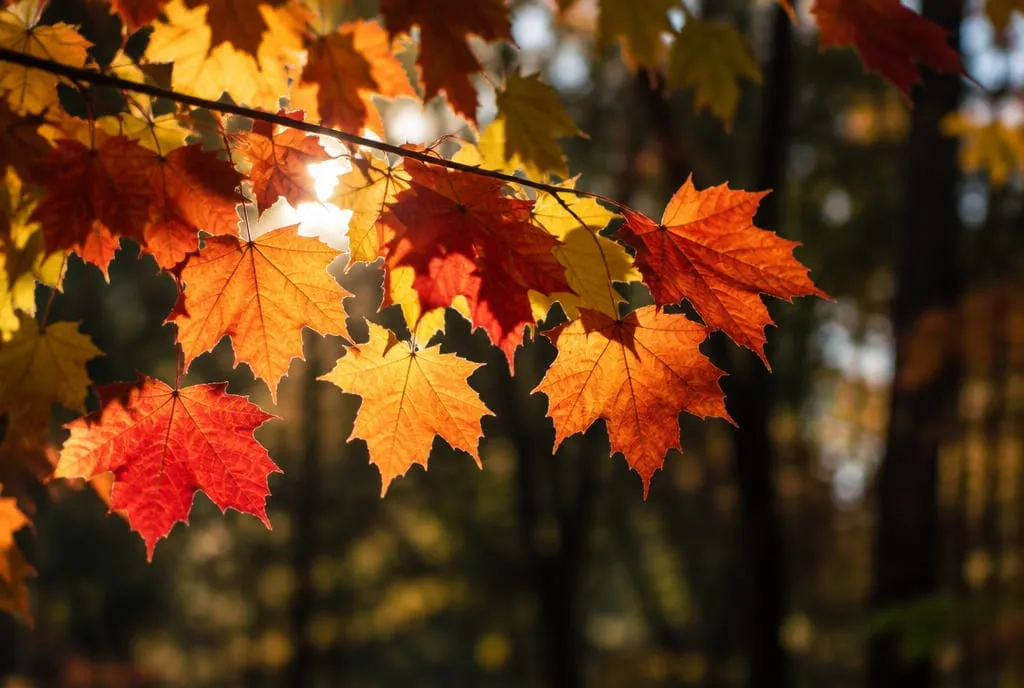 Backlit leaves: light passes through the blade, and the dark background lets the color stand out. Generated image to illustrate the concept, not a shot of a real place.
To expose, start from the highlights: lower the exposure until the peak on the right of the histogram stops short of the edge, so the brightest areas are not clipped. The dark background will fall into shadow, which is exactly what you want. For more technique, read backlit photography.
3. How do you use fog in autumn woods?
Look for low fog in the morning and build the photo in layers. Cool nights make fog more common; it forms mostly in valleys and over water and fades in the hours after sunrise, so you need to be in position before the light arrives. Nearby trees usually stay dark and crisp while distant ones fade, which softens the colors and calms the busy canopy.
Watch your exposure: fog is bright, and the meter tends to render it gray, so you usually need positive compensation. How much depends on the scene, so rely on the histogram, not a fixed rule. The full method is in fog photography.
4. How do you get autumn reflections on water?
Shoot early, when the air is still: mornings usually bring less wind, and calm water mirrors trees and sky. A small pond or even a puddle can be enough; you do not need a big lake.
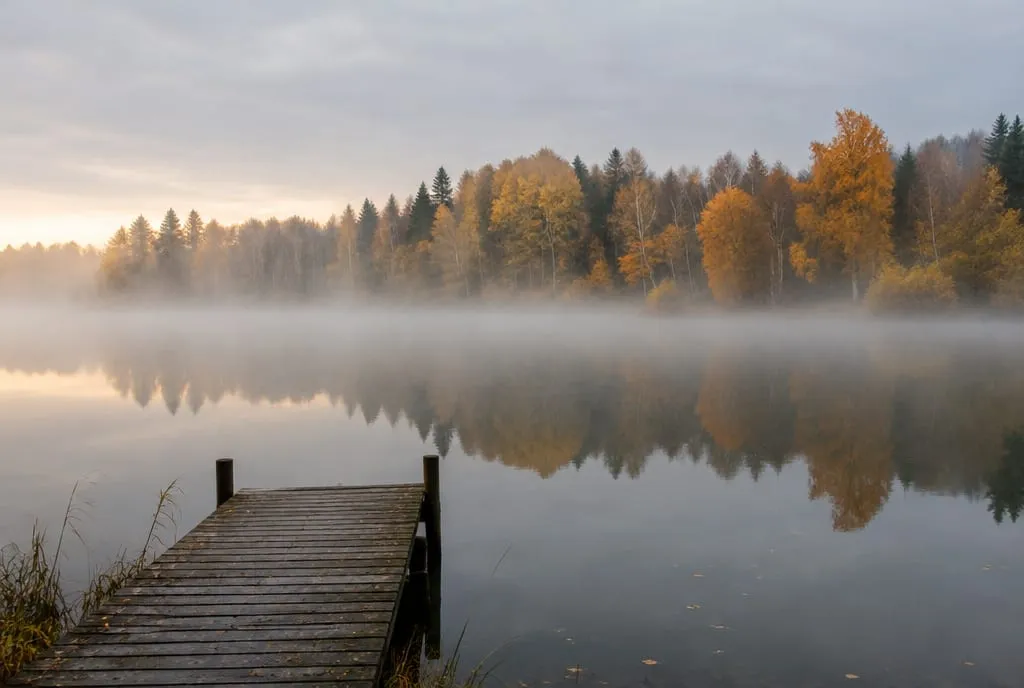 Low mist, still water and a jetty as foreground: three elements that build the scene. Generated image to illustrate the concept, not a shot of a real place.
Use a small aperture (for example f/8–f/11, as a starting point) to keep the jetty and the far shore sharp, and a tripod if shutter speeds get long. If the water is moving, a long exposure softens it and pairs well with the vivid colors of the woods, as Max Foster suggests.
5. How do you photograph a detail instead of the whole forest?
Move closer, or use a telephoto lens, to isolate a leaf, a lone tree or a small group of leaves. A whole forest can be a confusion of color; a small piece has a subject. A telephoto compresses the planes and leaves the rest out, as Max Foster notes; with a bright lens or a macro, a wider aperture blurs the background and isolates the subject.
Look for contrast: a red leaf against green, a pale leaf on a dark trunk. To decide what to keep in the foreground, use the logic in foreground interest in landscape photography.
6. How do you use a path and long shadows?
Find a path or road that enters from the bottom edge or a corner of the frame and leads the eye toward the back. With low sun, the trees throw long shadows across the path, and fallen leaves gain color and relief. It is a use of leading lines (see leading lines in photography) that gets stronger in autumn light.
Before you choose sunrise or sunset, check where the sun falls on your path: sunrise or sunset shows how. For the light itself, golden hour photography gives you the full picture.
7. How do you do intentional camera movement with trees?
Use a tripod, a shutter speed between 1/4 s and 1 s, and tilt the camera up or down while you press the shutter. Max Foster describes this technique mainly for straight tree trunks: the image keeps some detail but turns abstract, a bit like a painting. If it is very bright, a small aperture or an ND filter lets you lengthen the exposure without clipping the highlights.
It is the right idea when it is windy and nothing else works: you turn a problem (moving leaves) into a choice. Take a dozen tries, because results vary a lot from frame to frame.
8. What do you shoot when the leaves have fallen?
Bare branches and trunks, fog, the first frosts: simpler subjects, often in black and white. Without color, shape and contrast carry the picture, so look for an isolated tree against a plain background. If the background is an even sky or fog, the empty space becomes part of the composition: see negative space in photography.
How do you avoid the most common problems?
Check three things before you shoot.
- Wind: zoom to 100% on the leaves on your screen. As Max Foster points out, blur is easy to miss if you only look at the whole image; the fix is a faster shutter speed.
- Exposure: with fog, white clouds or bright light on the leaves, the meter gets it wrong: read the histogram.
- Color timing: the best foliage moment changes every year with rain and temperature. Max Foster advises checking local reports and not booking travel too far ahead; he prefers the start and middle of the color change, because it offers more variety than a woodland that is all yellow.
What to do next
A one-week exercise to see how light changes the same scene.
- Pick one spot near home with trees and a foreground (a path, a bench, a low wall). Note the spot and the lens you use.
- Shoot it three times in three different conditions over the week: overcast, low sun, and a hazy morning if one turns up.
- Adapt your technique to the light: in backlight, expose for the highlights; in haze, watch the histogram; under overcast, leave the sky out.
- Lay the three photos side by side and write one line for each: what does this light do to color, contrast and mood?
- Choose your favorite condition for this spot and write it down: you will plan your next outing around it.
For a second opinion, upload the photos to Framia and compare the light category score across the three conditions. To organize the outing itself, read how to plan a photo outing.
FAQ
What is the best time of day for autumn photos?
It depends on the look you want. Under overcast skies, colors look richer and glare drops, so you can shoot all day; with low morning or late-afternoon sun you get warmth and backlit leaves. Peak color also shifts from year to year with rain and temperature, so check local conditions a few days before you go.
Do I need a polarizing filter for fall colors?
It is not essential, but it helps. Leaves, especially wet ones, reflect the sky and look washed out; a polarizer cuts that glare. Rotate it while watching the scene and stop short of the maximum effect, because with a wide-angle lens the sky can turn uneven.
How do I stop wind from blurring the leaves?
Use a faster shutter speed and zoom in to 100% when you review the shot: a small blur is easy to miss on a small screen. If the wind is too strong to freeze without a very high ISO, change the idea: frame tighter in sheltered spots, or use the motion on purpose.
Can I take good autumn photos with a phone?
Yes. The light-based ideas (overcast, backlight, fog) work with any camera. On a phone, tap the screen on the area you want exposed correctly and lower the exposure if the leaf colors look washed out.
What can I photograph once the leaves have fallen?
Bare trees, fog and the first frosts. They give simpler subjects that often work well in black and white. When this happens depends on your latitude and altitude.