Sunrise or Sunset Photography: Which Should You Pick?
 by Marco Carotenuto · · 8 min read
You have one free day and one subject: do you get up before dawn or wait for the evening? Guides tell you opposite things, and forums are full of people who swear by one side. The honest answer is less ideological: the right choice depends on where the sun sits relative to your subject, how the air behaves in your location, and how much effort you’re willing to spend.
This guide covers what actually changes between the two moments, what is only opinion, and how to decide in four questions. If you want the basics of low light first, start with golden hour photography.
Is sunrise light different from sunset light?
Physically, at the same sun height, the light is very similar: the rays cross the same amount of atmosphere whether it’s morning or evening. The sources disagree about what follows from that, and it’s better to say so than to pick a side.
According to Photography Life, sunrise light is cooler and the air clearer, because particles settle overnight; at sunset, after a day of activity and heat, the air is usually more loaded. Tim Shields argues instead that there is no optical difference: what changes is the direction of the shadows and which objects get lit. The two views can be reconciled this way: the geometry is the same, but the state of the air can differ from place to place and day to day. After a storm, or in strong wind, evening air can be very clear; an autumn morning on a plain can be saturated with moisture.
In practice: don’t assume sunrise is “cooler” or sunset “redder”. Check on the spot, and look at the sky before you decide how to expose.
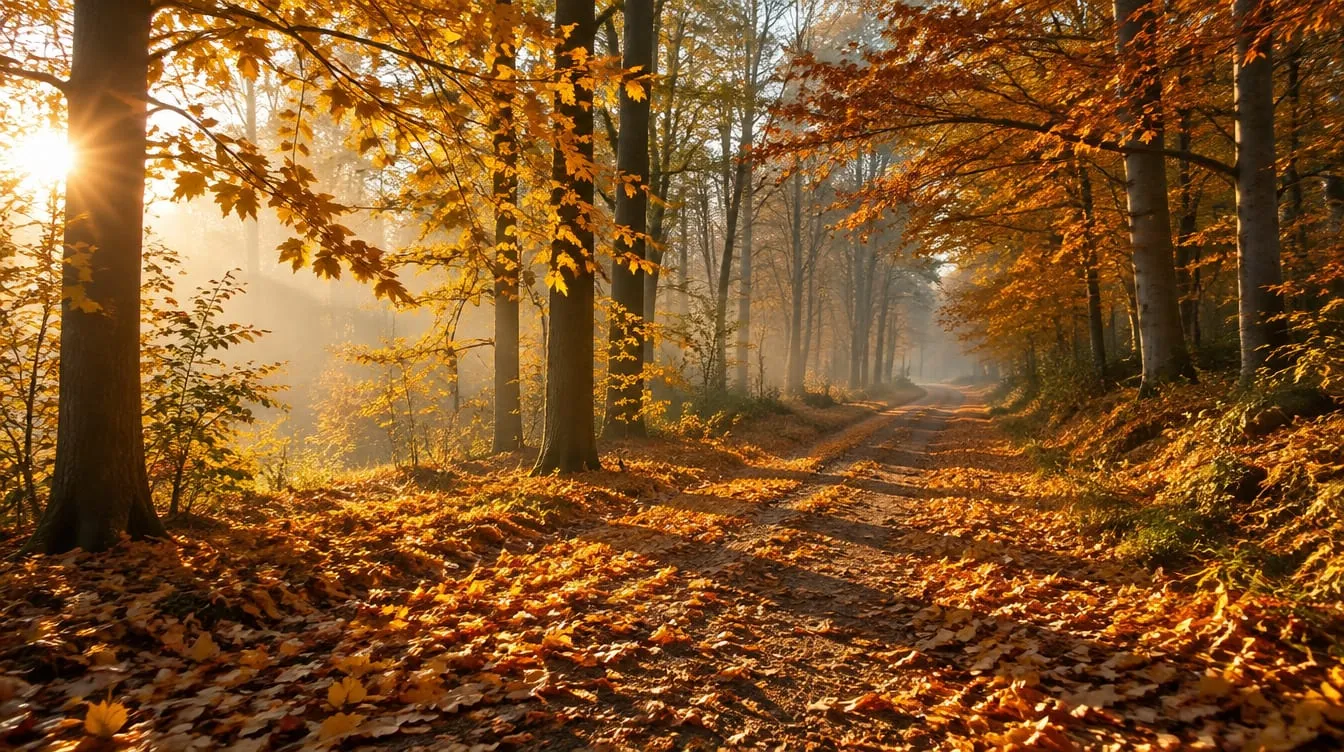
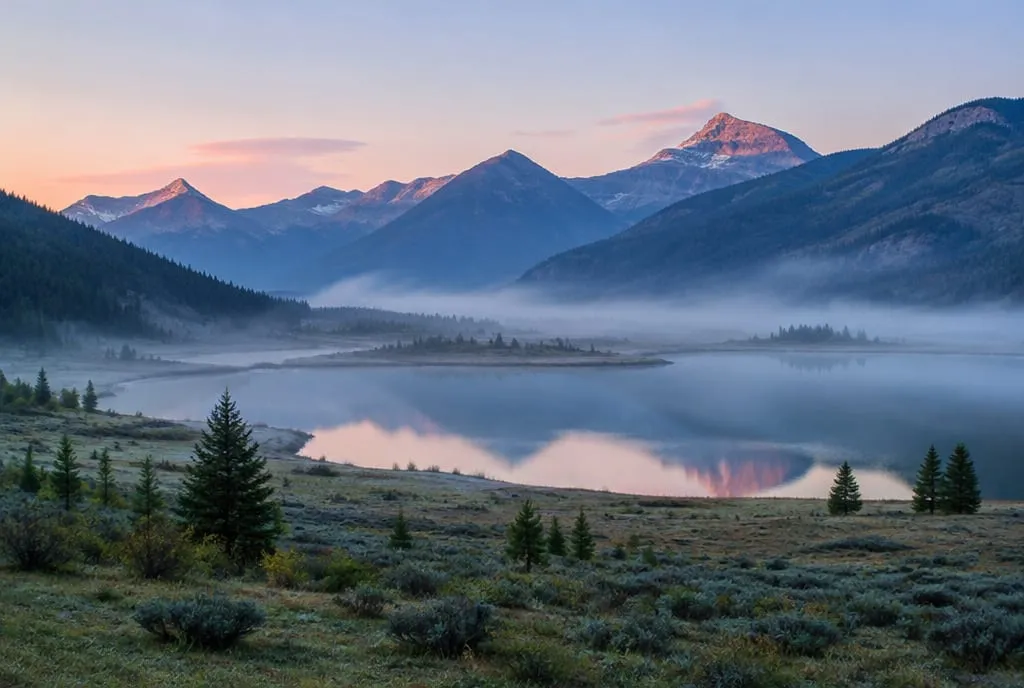 A typical sunrise as guides describe it: clear air, cool tones, low mist over the water. It’s not a rule: an illustrated example of the concept, not a photo of a real place.
Why does sun direction matter more than color?
Because it decides which surfaces light up and where the shadows fall, and that changes a photo more than any tint. The sun rises and sets in roughly opposite directions: only around the equinoxes does it rise almost exactly east and set almost exactly west. In the northern hemisphere, in autumn and winter it rises toward the southeast and sets toward the southwest; in summer, toward the northeast and northwest.
| What you’re looking at | At sunrise | At sunset |
|---|---|---|
| A wall or facade facing east | Lit by raking sun | In shadow |
| A wall or facade facing west | In shadow | Lit by raking sun |
| Sun in the frame | If you face east (backlight) | If you face west (backlight) |
| Long shadows point toward | West | East |
You see it clearly in landscapes: a mountain lights up on one face in the morning and on the other in the evening, so a shot of that face in morning light can’t be redone at night. If you want to shoot into the sun, read backlit photography too.
The practical move: before choosing, open a map or a sun calculator (timeanddate’s also shows the sun’s height through the day) and check where it rises and sets on your day, at your place. It takes two minutes and saves you from waking at 4 a.m. only to find the sun rises behind the mountain.
When is sunrise the better choice?
When the subject faces east, when you want quiet, and when you’re hoping for mist. The most concrete reasons:
- Fewer people. As Photography Life and Tim Shields point out, most people are asleep, so it’s easier to get a spot. At very famous places, though, even sunrise can have a queue.
- Mist and fog are more likely. Cool nights favor low fog over valleys and lakes, which then burns off with the sun: see fog photography. You can’t schedule it, but if you want it, morning is when it’s most likely.
- Wildlife is more active. If you photograph animals, dawn offers more chances.
- A second chance the same day. If sunrise goes badly, you still have sunset that evening.
- Walking back in daylight. You start in the dark, but you finish with the sun up, a real advantage after a hike.
The catch: you have to be set up before the light, so you need to have seen the place by day and know where you’ll stand. If you haven’t scouted, you’ll compose with a flashlight and risk the wrong frame.
When is sunset the better choice?
When the subject faces west, when you want more time to study the scene, and when you care about what happens after the sun goes. As Tim Shields notes, the main advantage is that you can arrive in daylight, look for your framing calmly and set it up before the light arrives.
- More information when you decide. In the afternoon you can look at the sky and see whether clouds are opening or closing; for sunrise you decide the night before, with the sky still unseen.
- There’s still a scene after the sun. Right after sunset comes blue hour, with cities lit and windows glowing: see blue hour photography.
- Less sacrifice. For many people the alarm clock is the real obstacle: on long summer days sunrise comes very early, and a trip you don’t make produces no photos.
The catch: the spot can be crowded, and the walk back after dark, especially on a trail, calls for a headlamp and extra care.
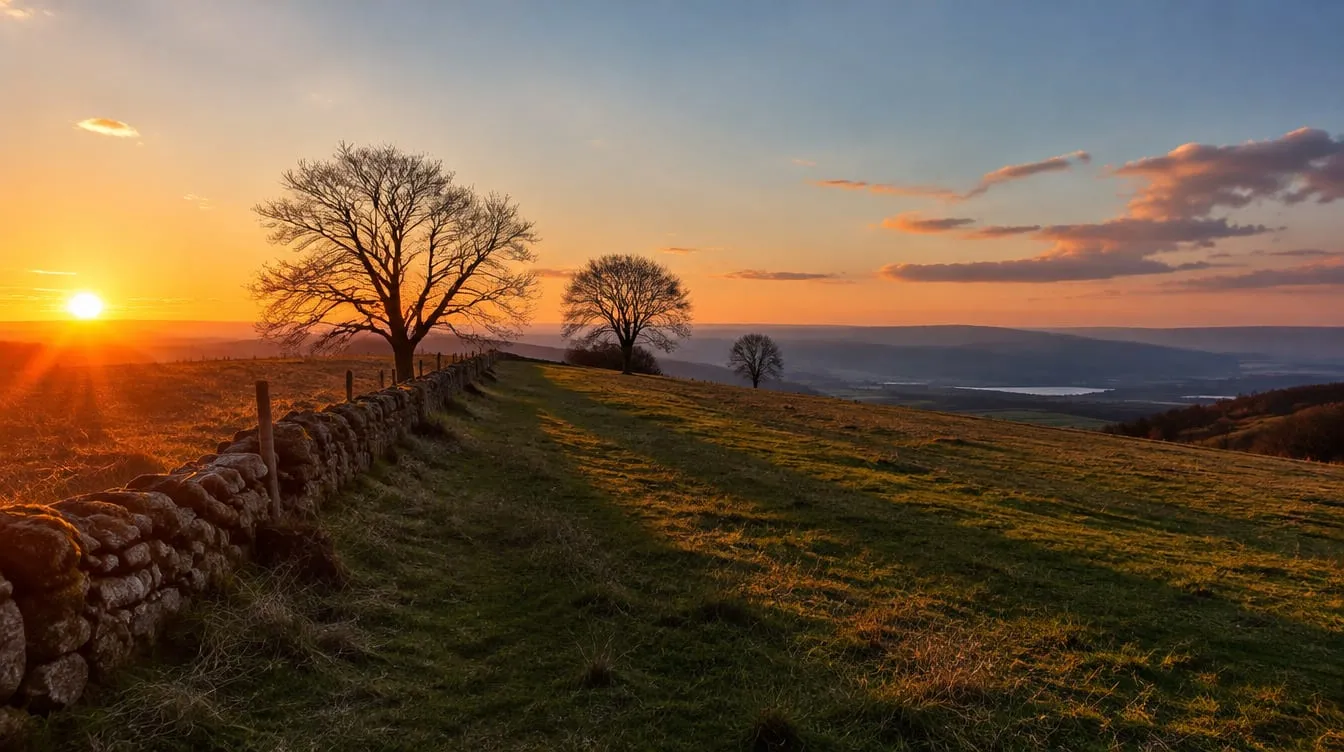
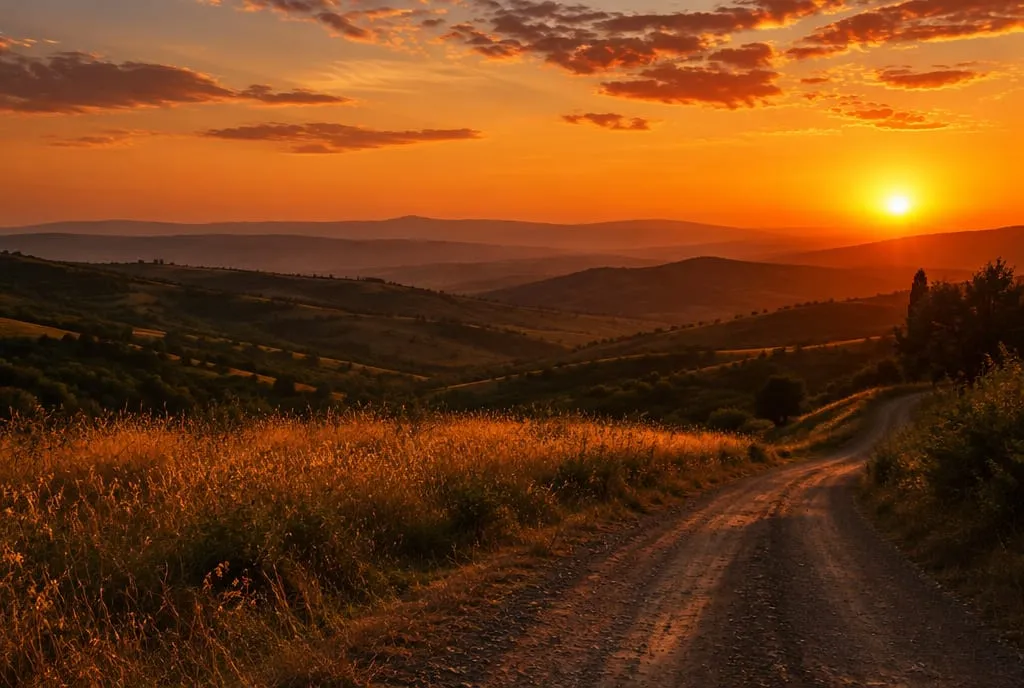 A sunset with warm colors and a rich sky: an illustrated example, not a “typical” sunset. With clean air, evening light can also be cool and clear. Generated image to show the concept, not a photo of a real place.
How do I choose by subject?
Start from the subject, not the clock. This table sums up the most common choices; when in doubt, check the sun’s direction with a calculator.
| Subject | Starting choice | Why |
|---|---|---|
| Mountain face or facade facing east | Sunrise | That’s when the sun rakes across it |
| Face or facade facing west | Sunset | Raking sun only arrives from there in the evening |
| Sea with the sun rising out of the water | Sunrise (east-facing coast) | The sun rises over the sea horizon only from that coast |
| Sea with the sun dropping onto the water | Sunset (west-facing coast) | The opposite holds |
| Valleys, lakes, meadows with possible mist | Sunrise | Low fog is more likely in the morning |
| Cities, streets, lit windows | Sunset and blue hour | Movement and artificial lights come on in the evening |
| Wildlife | Sunrise | Animals tend to be more active |
| A place you don’t know | Sunset, or sunrise after a daytime scout | Sunset lets you study the scene in daylight |
If it’s a famous location, add one more question: what is less seen? As Tim Shields notes, since most people see more sunsets than sunrises, morning light can feel less familiar.
How do I decide in four questions?
Answer in this order and stop at the first question that gives a clear verdict.
- Where does the sun hit my subject from? If only one of the two directions lights it, you’ve already chosen.
- What’s the weather? Look at cloud forecasts. Tim Shields suggests aiming for few clouds or only high clouds, which don’t block the sun at the horizon and then light up red and orange. No forecast is certain: trust the data, but bring a plan B.
- Do I know the place? If not, choose sunset, which lets you see the scene by day, or scout in daylight before a sunrise.
- What does the alarm really cost me? If getting up wrecks your focus, a photo done well in the evening beats one done badly at dawn.
To build the outing around this choice, how to plan a photography trip walks you through light, weather and backup plans. On Framia, AI Planning pulls together light times, weather and shooting spots from what you want to photograph; the choice between sunrise and sunset remains your call in the field, because it also depends on your energy.
What if I don’t want to choose?
Shoot both, but with a method: pick one subject and one lens and return to the same spot once at sunrise and once at sunset, within a few days. If you’re on a multi-day trip, use the first day as a scout: see where the sun lands, then decide which of the two moments deserves the next wake-ups. Stay a few minutes after sunset and arrive with some margin before sunrise: the light just after or just before the sun is very different and can give you the best frame.
What to do next
A one-week comparison on the same scene, so you decide with your own eyes rather than opinions.
- Pick a still subject (a tree, a facade, a stretch of coast) and a vantage point you can reach in minutes. Check with a sun calculator where the sun rises and sets.
- Make two outings: one at sunrise and one at sunset, within a few days. Use the same lens and the same framing. Arrive half an hour early.
- Shoot at the same sun height. As in the golden hour exercise, use shadow length: shoot when your shadow is about four times your height, then again at 15-minute intervals.
- Score five things from 1 to 5 for each outing: direction of light on the subject, color, contrast, interest of the sky, and effort (5 = little effort).
- Add them up and write one sentence: “for this subject, at this place and time of year, the winner is…” That’s your rule, valid until the season changes.
For a second opinion, upload the best frame from each outing to Framia and look at the light category score: compare it with your own marks. If you want to see how a photo is judged on every criterion, read how to evaluate a photo. And for reading light more generally, there’s light in photography.
FAQ
Is sunrise really better than sunset for photography?
Not in an absolute sense. Many photographers prefer sunrise for the quiet, the smaller crowds and the mist, but at the same sun height the light itself isn't better: what matters is where it falls on your subject. If your subject is only lit by the setting sun, then for that subject sunset is the right call.
Do sunrise and sunset have different colors?
Sometimes, but there is no rule. Some sources argue sunrise is cooler and clearer because night air is cleaner; others, such as Tim Shields, say there is no optical difference between the two. It depends on place, season and the day, so check on the spot rather than assuming.
Which lasts longer, sunrise or sunset?
Neither, consistently. How long the low light lasts depends on latitude and season, not on whether the sun is rising or setting: for the window between 6° below and 6° above the horizon, timeanddate gives about 50 minutes near the equator and over 90 minutes at 60° latitude in March.
Can I shoot sunrise and sunset on the same day?
Yes, and it's a good way to compare them on one subject. If you only have one vantage point, go back to the same spot with the same lens so the comparison is fair. In summer the days are long, so plan some rest in between.
What are the safety differences between sunrise and sunset?
The dark falls at different points of your route. At sunrise you walk in the dark on the way out and in daylight on the way back; at sunset it's the opposite, and descending tired in the dark is riskier. Either way, bring a headlamp and consider going with someone, especially in the mountains.