Frame Within a Frame Photography: How to Use It Well
 by Marco Carotenuto · · 9 min read

You are looking at a beautiful valley, you shoot, and on the screen it is an ordinary picture: everything is far away and nothing matters more than anything else. Frame within a frame can change that: take a step back, look at what stands between you and the valley, and use it to surround the view.
Below you will find which elements can work as a frame, three checks to tell whether yours does, how to expose when the frame is in shadow, how to focus, and when it is better to give up. An hour-long exercise closes the article.
What is frame within a frame in photography?
Frame within a frame means using an element that is already in the scene to surround, fully or partly, your subject: an arch, a window, a set of branches, the mouth of a cave. You do not build it; you change your position until the right element falls around what you want to show. The edge of the picture is the first frame, and the one in the scene is the second.
Frames come in families, and each family has its own watch-outs:
| Family | Examples | What to watch |
|---|---|---|
| Architecture | Doorways, windows, arches, arcades, tunnels | Straight lines, verticals that do not converge |
| Vegetation | Branches, foliage, trunks, tall grass | That it does not become a tangle over the subject |
| Rock and ground | Rock arches, caves, gaps, dunes | An even dark tone, a clean shape |
| Light and shadow | Cast shadows, the silhouette of a hill | Exposure for the subject, not the shadow |
| Transparent or reflective surfaces | Car windows, glass doors, mirrors | Unwanted reflections, dust |
In the cover photo the rock arch does almost all the work: the sea and the tiny boat become the subject because they are the bright, colorful part inside the opening. Take the arch away and the same bay is a pleasant view and nothing more.
What does a frame do for a photo?
A frame does one of four jobs, and it helps to know which one you need before you look for it. If none comes to mind, you probably do not need a frame.
- Guide the eye. The edges of the frame point to where you should look. It is the best-known job, and it works for a simple reason: the eye goes to the brightest, highest-contrast area, and a dark frame isolates it.
- Add context. A stone arch around a person says where they are without a caption. The subject stays small, but the place reads.
- Create depth. A near frame and a distant subject sit on different planes, so the eye feels the distance. If your pictures tend to look flat, this is one of the causes covered in why photos look flat.
- Hide an empty area. A white sky or a weak foreground can be covered with branches or rocks, as long as the frame is more interesting than the emptiness it hides.
One more distinction: a frame is a foreground element, but it is not the same as a foreground subject. In foreground interest in landscape photography the near element is a lead or a partner of the subject; here it is a border that has to read quickly and must not steal the scene.
How do you tell if a frame is working?
Run three checks on the shot you just took, one after another: hierarchy, opening and job. It is our own grid, meant for looking at a picture with a cool head, before you get attached to the scene.
| Check | The question | If the answer is no |
|---|---|---|
| Hierarchy | Squinting, or looking at a thumbnail, does the eye land on the subject first? | Darken the frame, simplify it or move until the eye lands on the subject first |
| Opening | Does the subject sit inside the opening with some air on every side, without touching the edges? | Move a few steps or recompose until there is no contact |
| Job | Can you say in one sentence what the frame adds (guide, context, depth, hides a gap)? | Remove it: a frame with no job is decoration |
The second check is the one people miss most often. When the subject grazes the edge of the opening, the eye sees a contact point and a small tension: it looks like a mistake, not a decision. A little air around the subject is usually enough to fix it.
In the photo below the frame is a stone and wood doorway in shadow, with a bright valley outside. It passes all three checks: the eye goes to the lit valley, with the hut and the path, not to the doorway; the subject sits inside the opening without touching the edges; and the doorway adds context and depth.
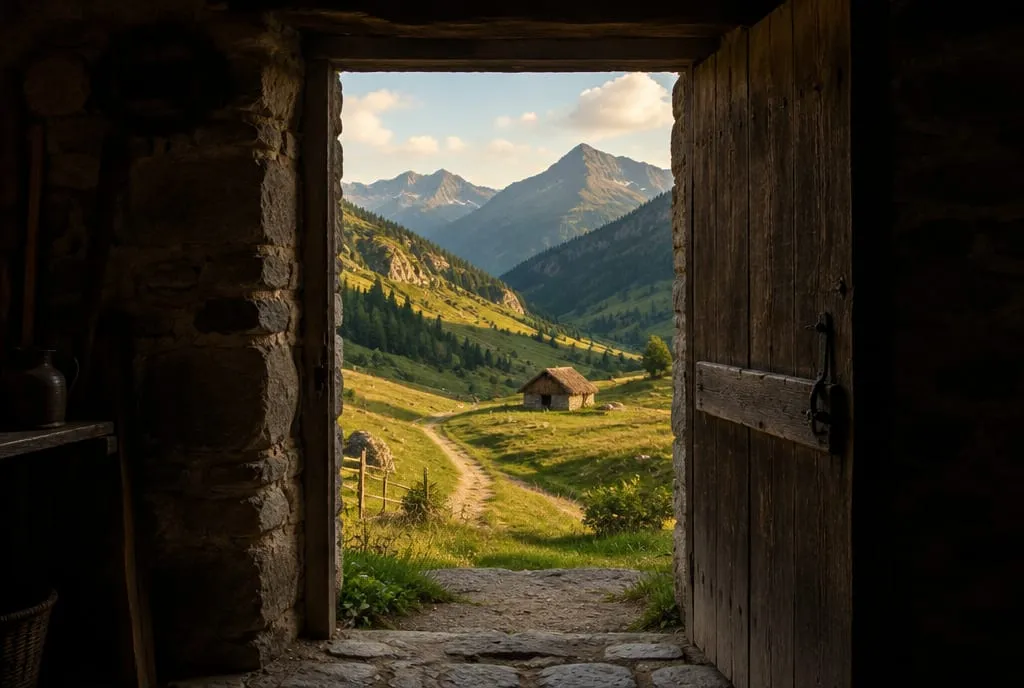 Generated image to illustrate the concept: the frame is much darker than the valley, and that is right. Expose for the bright part; the darkness of the doorway provides the contrast.
If the scene has many competing elements, the checks in our guide to photography composition can help you sort them out.
How do you expose a scene when the frame is in shadow?
Expose for the subject, not the frame: the dark frame can stay dark, the subject cannot. This is the most common technical problem with the technique, because the meter sees a mostly dark scene and tends to brighten it, which burns the bright area that was the reason for the shot.
What to do, in order of simplicity:
- Meter on the subject. With spot metering (or by placing the focus point on the subject, if your camera links the two) the reading comes only from the bright part.
- Or use exposure compensation. If the camera keeps brightening, dial in negative compensation and check the result.
- Check the histogram and the highlight warning. If the graph is piled against the right edge, the highlights are clipped: darken further. If the frame is a silhouette, leave it, as long as it is a choice.
- If the frame must keep detail, remember that a sensor cannot always hold the whole gap between shadow and light. In that case take three exposures and blend them later, wait for softer light or accept the silhouette.
A different case is when the sun is behind you: frame and subject get the same light, and exposure is much easier. But the picture often loses the contrast that gave the frame its strength.
How do you focus with a close frame?
You have two options, and your choice changes the character of the picture. Decide before you shoot whether you want the frame sharp or soft.
| Goal | How | What to expect |
|---|---|---|
| Everything sharp | Stop down (as a starting point, f/8-f/11) and focus a little beyond the frame | Frame and subject both readable; if the frame is only a few inches away, one shot may not be enough |
| Soft frame | Open the aperture, focus on the subject and move closer to the frame | The frame turns into a wash of color and the subject stands out |
With a very close frame, say branches half a meter from the lens, keeping both the edge and a distant valley sharp in a single shot is often impossible. You can combine several shots with the focus shifted (focus stacking) or choose the soft frame and make it a decision rather than a compromise.
One detail that is easy to miss: the ratio between subject and opening changes only when you move, not when you zoom. Zooming enlarges everything equally. If the subject looks too small inside the frame, step back and use a longer focal length: the frame stays around it, but the subject fills more of the opening.
When does a frame ruin the photo?
A frame ruins the photo when it takes the eye instead of the subject. It happens in three ways, and you can almost always spot it by one sign: the eye keeps circling the edges.
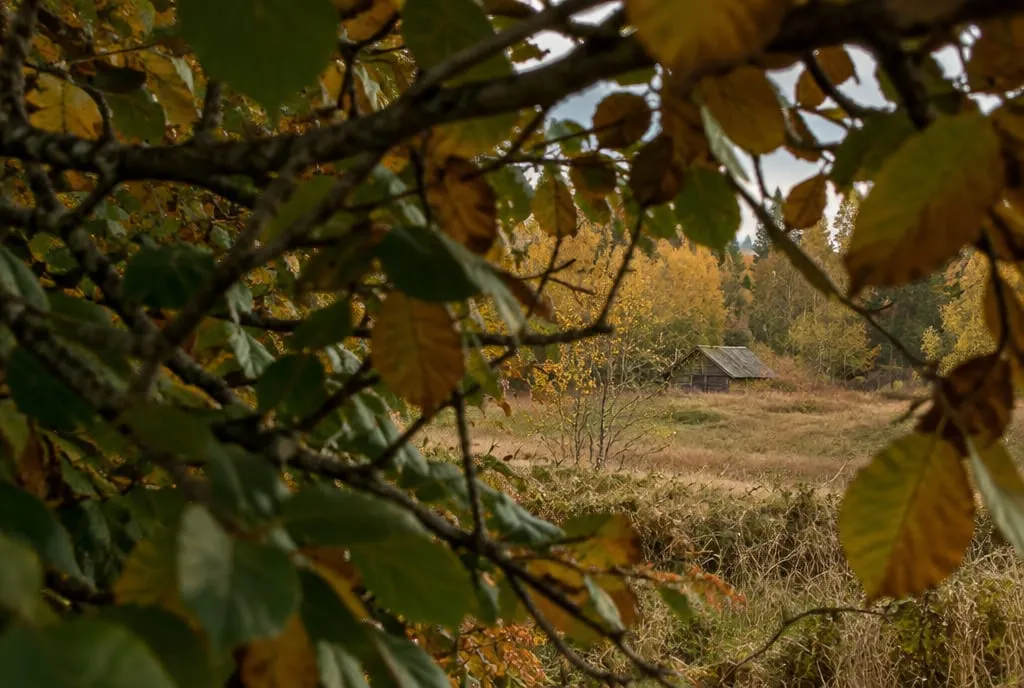 Generated image to illustrate the concept: the hut is there, but the branches and leaves take up so much room and carry so much contrast that the eye wanders without a place to rest.
- Too much frame. When branches cover half the picture, it is no longer a frame: it is an obstacle. Move until the opening is clearly more important than the border.
- A frame more interesting than the subject. Golden leaves or a decorated arch with strong contrast pull harder than a distant hut. Choose a simpler frame or change the light on it.
- A frame with no reason. If you remove it and the picture loses nothing, your branch was just noise.
As with negative space, what counts is the relationship between full and empty: here the “full” is the frame, and it must not smother the subject.
How do you combine frames with symmetry and leading lines?
A frame works well with other structures, as long as you pick one to dominate. A doorway seen head-on is already symmetry; if the path beyond it curves, you also get a leading line pulling the eye through the opening. Several structures together can make a strong photo, but every extra one raises the risk of confusion.
To pick the dominant one, ask what you want the eye to do first: enter the opening (frame), follow a path (leading line) or settle on the axis (symmetry). The others become support.
How does Framia score it?
A frame weighs mostly on the composition criterion, one of Framia’s six analysis categories. A frame that guides the eye, leaves air at the edges and has a clear job works in favor of the score. If the frame is heavy, touches the subject or competes with it, you usually land in the 55-69 band of the scale: the intention is visible, the execution has clear limits.
What to do next
A one-hour exercise with a doorway, a window, an arch or some branches near you:
- Find a subject (a building, a tree, a person seen from behind) and a possible frame between you and it.
- Take a first photo without the frame, just the subject.
- Take a second photo with the frame close, filling a good part of the picture.
- Take a third photo after stepping back and using a longer focal length, so the subject fills more of the opening.
- For each of the two photos with a frame, take two versions: one exposed for the subject and one exposed for the frame. See what happens to the bright areas.
- Put the photos side by side as thumbnails and apply the three checks: hierarchy, opening, job. Note which version passes.
- Write one line: does the frame here guide, add context, create depth or hide a gap?
If you want a second opinion, upload your best shot to Framia and read the composition score: the explanation tells you whether the frame is helping the subject or taking space from it.
FAQ
Does the frame have to be dark?
No. A dark frame is the most common because a lighter subject stands out by contrast. But a frame can also be pale, like a ring of fog or snow, or simply a different color. What matters is that it is less eye-catching than the subject and does not cover it.
Can I do this with a phone?
Yes, and it is usually easier than it looks. Tap the screen on your subject: focus and exposure adjust to it, so the dark frame stays dark and the subject is exposed properly. If it is still too bright, drag the exposure slider that usually appears next to the tap point.
Can I put one frame inside another?
Yes, but every extra layer takes space from the subject. A doorway that opens onto a courtyard with an arch at the far end can work, as long as the subject stays clear. If you cannot find where to look after the second layer, remove one.
Does a vignette in editing count as a frame?
It is a fake frame, and sometimes it is enough to reinforce a real one: darkening the edges slightly pushes the eye toward the center. But it cannot create a structure that is not in the scene. Without a real element around the subject, the effect usually reads as editing straight away.
Does this work with the rule of thirds?
Yes. The opening of the frame can be centered or off to one side, and the subject can sit on a third of the opening instead of the middle. The empty space inside the frame works like any other space in the picture.