Symmetry in Photography: When the Center Works
 by Marco Carotenuto · · 8 min read

Put your subject in the middle and someone will call it a mistake. Then you see a facade or a mountain lake shot dead center and it looks great. The difference isn’t the center: it’s whether you had a reason to choose it.
Below you’ll find the types of symmetry, three checks to run before you press the shutter, how to use reflections, when to leave the rule of thirds alone, and how to interrupt symmetry with a single element. A one-hour exercise closes the article.
What is symmetry in photography?
Symmetry is a scene where the two parts of the frame correspond across an axis or around a point. The halves don’t have to be identical: The School of Photography describes it as two halves that hold the same weight and balance each other.
The type of axis changes how you shoot it:
| Type | What it looks like | Where you find it | What to check |
|---|---|---|---|
| Vertical | A straight axis splits left from right | Facades, bridges, staircases, corridors | Camera on the axis, vertical lines straight |
| Horizontal | Upper and lower halves mirror each other | Calm lakes, puddles, glass walls | Still water, clean reflection line |
| Radial | Elements open out from a center | Domes, spiral stairs seen from above, flowers | Camera over the geometric center |
| Repetition | Identical elements at regular intervals | Rows of windows, columns, lampposts | Steady rhythm, no accidental intruders |
In the lake photo above, the reflection line is horizontal and the peak sits on the vertical axis: a double symmetry, with both lines falling roughly in the middle of the frame.
When does the center work, and when doesn’t it?
The center works when the scene itself is symmetrical. The structure asks for it, and moving the subject to a third would break the geometry. It works badly when the subject is asymmetrical or the center is simply the most convenient place to point the camera.
To tell which side you’re on, run three checks on your photo, one after the other. They are our own checklist, made for looking at a shot with fresh eyes:
| Check | The question | If the answer is no |
|---|---|---|
| Axis | Does the axis really run through the middle of the subject (door, peak, center column)? | Move sideways until it does |
| Margins | Is the space between the subject and the frame edge the same on the left and on the right? | Crop or reframe: even a few pixels of difference show |
| Verticals and horizon | Are vertical lines straight and the horizon level? | Level the camera; fix it in editing if needed |
If two of the three fail, the photo isn’t symmetrical, it’s just centered. A quick test: use a vertical guide in the middle (many cameras and apps offer one; otherwise draw it in an editor) and see whether the subject’s axis lands on it.
In the example below the yellow line marks the axis: cross, window, doorway and step all sit on it, and the two side windows are the same distance from it.
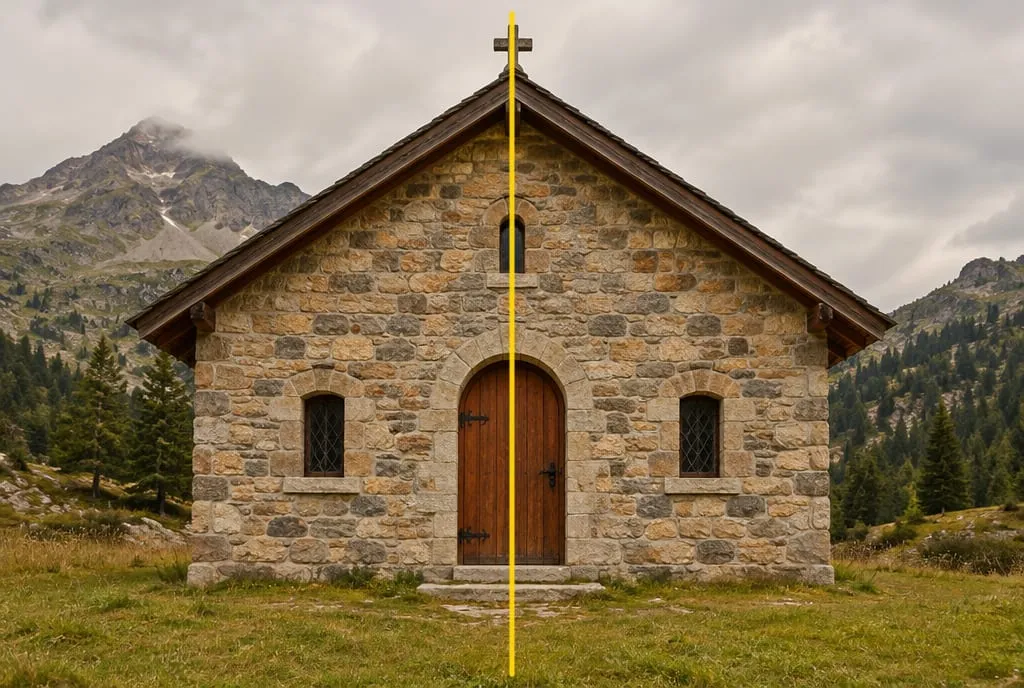 Image generated to illustrate the concept: the facade is symmetrical, the mountain background is not. That’s fine, because symmetry is about the subject, not the whole frame.
For the bigger picture of where symmetry sits among your other choices, read our complete guide to photography composition.
How do you shoot a symmetrical scene without mistakes?
Start from the axis, not from the grid: find the line that divides the scene, then put the camera exactly on that line. Almost every symmetrical photo that doesn’t convince fails right here.
Five moves, in order:
- Find the axis before you raise the camera. It might be the central door, the peak, the chimney, the waterline.
- Stand on the axis. Even one step sideways makes one side of the facade look bigger than the other, and the symmetry breaks.
- Keep the camera level. Tilt it upward and the vertical lines converge toward the top, so the facade seems to lean backward.
- Choose your distance. The closer you get, the more of the frame symmetry fills. The more you include, the more likely something off-axis will disturb it.
- Check the edges. A sign or a branch on one side only shifts the weight of the image.
Digital Photography School adds a useful detail: for a building, aim to keep the sensor parallel to the facade.
How do you use reflections to create symmetry?
A reflection gives you symmetry for free, but only if the surface is still and the reflection line is sharp. A calm lake, a puddle, a glass wall, a car roof, a switched-off screen: any smooth surface can act as a mirror.
Four adjustments:
- Wait for still water. A few ripples are enough to break the mirrored details. Wind often drops at sunrise and sunset, which is when water settles most easily.
- Lower the camera. As a rule, the closer you are to the water or a puddle, the more of the reflected scene enters the frame: it comes down to the angle of incidence.
- Take off the polarizer. That filter can cut reflections, so it works against you here.
- Decide where the line falls. In the middle for a rigorous image. A little above or below for a more dynamic symmetry: the mirror stays, but the photo isn’t split in half.
For where to put the reflection line and when a mid-frame horizon is the right call, see where to put the horizon in a photo. The one fixed point: you need a sharp reflection. With rippled water the two halves don’t match and the photo reads as two images competing for attention.
Symmetry and the rule of thirds: do they exclude each other?
No: they are tools for different scenes. The rule of thirds works well for asymmetrical subjects and scenes with a dominant direction. Symmetry works when the scene’s structure is mirrored. The question isn’t “which rule?” but “how is this scene built?”
| Situation | Recommended choice |
|---|---|
| Head-on facade, bridge, corridor | Center, straight axis |
| Lake with a sharp reflection | Reflection line in the middle, or on a third for more energy |
| Single asymmetrical subject (person, animal) | A third, space in front |
| Symmetrical scene with one off-axis element | Center for the structure, element on a third |
Leading lines complete symmetry when a corridor or a road converges on a vanishing point in the middle: there, symmetry also becomes a way to guide the eye.
How do you break symmetry on purpose?
Place a single element off-axis inside a very orderly structure. The eye reads the regularity first, then notices what doesn’t match: that element becomes the subject. Street photographers use this a lot.
In the arcade below, the pillars, arches and lanterns build a near-perfect order around the axis. One figure, shifted to the right, turns geometry into a small story.
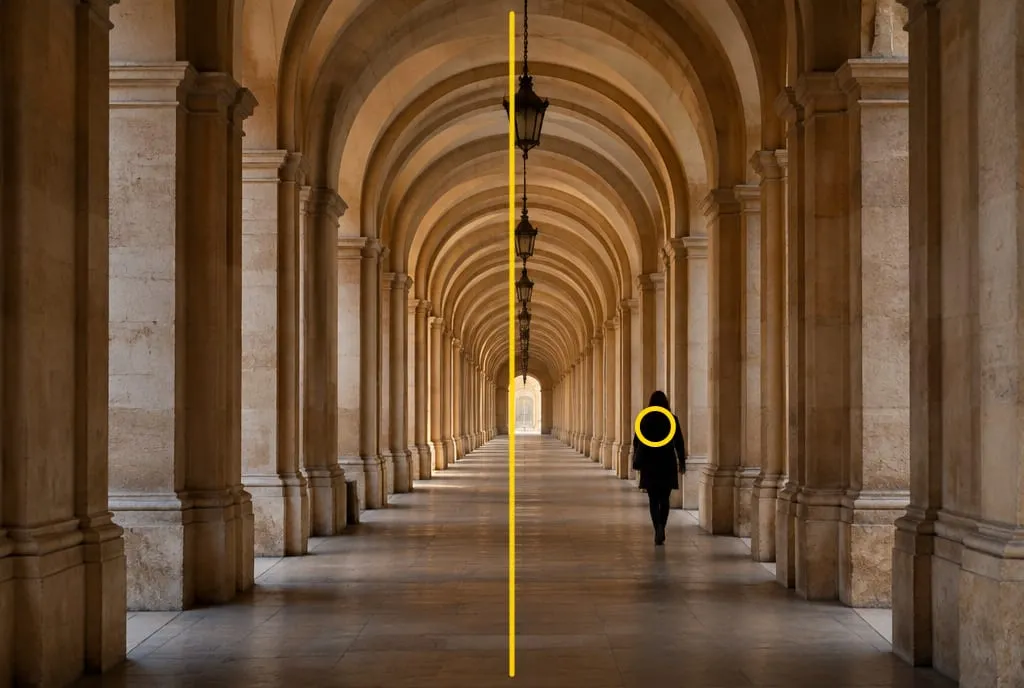 Image generated to illustrate the concept: the yellow line marks the axis, the circle marks the figure that breaks it. Without the figure the photo would be orderly; with the figure it has a subject.
Three rules to do it well:
- One element only. Two scattered elements turn back into clutter.
- Small enough not to beat the structure. If it fills half the frame, it’s no longer an interruption.
- Distinct in tone or color. A dark figure on a light ground, or the reverse, reads at once. As with negative space, contrast does the work.
Does symmetry have to be perfect?
It depends on what you want to say. For a graphic, rigorous image, the two halves need to match. But in the real world, perfect symmetry is rare: even a face isn’t perfectly mirrored. A near-symmetry with a few differences is often livelier than a clean but predictable one.
The practical rule: if the intention is rigor, every deviation shows and should be fixed; if the intention is atmosphere, a small deviation is acceptable as long as it looks chosen. In editing, a crop of a few pixels or a perspective correction is almost always enough to recover the axis.
How does Framia score it?
Symmetry weighs mostly on the composition criterion. A well-executed symmetry (clean axis, equal margins, straight lines) works in favor of the score. If the center has no reason, or the verticals converge and the margins differ, you land in the 55-69 band of the rubric: the intention is visible, the execution has clear limits.
What to do next
A one-hour exercise with a facade, a doorway or a corridor near you:
- Find a symmetrical structure and identify the axis.
- Take a first photo on the axis, camera level, with a vertical guide in the middle.
- Take a second photo thirty centimeters (about a foot) to the side, changing nothing else.
- Take a third photo tilting the camera upward.
- Put the three photos side by side as thumbnails and apply the checks: axis, margins, verticals. Note what changes.
- Wait for a person or any off-axis element to pass and take a fourth photo. Compare it with the first: what changed?
- Write one line: does the symmetry here say order, calm or tension?
If you want a second opinion, upload your best shot to Framia and read the composition category score: the explanation tells you whether the axis and margins are working.
FAQ
Does the subject have to be in the center of a symmetrical photo?
Usually yes, because the axis of symmetry sits in the middle. The exception is a symmetrical scene, such as a tree reflected in a lake: you can move the reflection line higher or lower and the photo still works, because the two halves remain mirror images.
How perfect does symmetry have to be?
It depends on the effect you want. For a rigorous, graphic image like a facade or a corridor, the two halves need to match closely. If you only want a feeling of order, a small irregularity, a shadow or a person on one side, can make the photo feel more alive.
Why does my symmetrical building look crooked?
Almost always for one of two reasons: the camera is off the building's axis, or it is tilted upward and the vertical lines converge. Move until the margins on both sides are equal, keep the camera level and, if needed, correct the perspective in editing.
Is symmetry always boring?
No, but it turns static when there is no reason for it: a weak subject, flat light, a center chosen only because it was convenient. With strong geometry, good light or one element that interrupts the order, symmetry produces very striking images.
Can I use the rule-of-thirds grid on a symmetrical scene?
You can leave it on, but for a symmetrical subject the useful line is the vertical one in the middle. Put something else on the thirds: the horizon of a reflected landscape, or the element that breaks the symmetry.