Hard Light vs Soft Light: How to Tell and When to Use Each
 by Marco Carotenuto · · 10 min read
Same subject, same camera, two different days: on one the shadows are cut with a knife and the rock looks carved, on the other everything is blurred and gentle. Neither light is right or wrong; they just have different characters. Calling light hard or soft is the first step to knowing what to expect from a shot and what to do when you do not get the light you wanted.
Here you get a definition that holds up in the field, a practical rule for measuring how hard the light is with a ruler, a table for choosing by subject, and an exercise for one sunny afternoon. If you want the big picture first, start with how to read light in photography.
What is the difference between hard and soft light?
Hard light gives crisp shadows and high contrast; soft light gives blurry shadows and low contrast. According to Wikipedia, soft light tends to “wrap” around objects and casts diffuse shadows with soft edges, while hard light is more focused and produces harsher shadows.
| Hard light | Soft light | |
|---|---|---|
| Source, as seen from the subject | Small | Large |
| Shadow edge | Crisp | Blurry, or no shadow at all |
| Contrast | High | Low |
| Texture | Emphasized, especially when the light skims the surface | Reduced |
| Examples | Sun in a clear sky, bare flash | Overcast sky, open shade, window with a curtain, softbox |
| Risk | Blown highlights and blocked shadows | A dull shot, a blank white sky |
Neither is better. Photography Life puts it plainly: the choice depends on the look you want and should be a conscious one. Soft light flatters the subject, which is why it is favored in portrait, macro and product work; hard light adds drama, brings out texture, and suits bold landscapes and moody portraits.
What does the hardness of light really depend on?
On the apparent size of the source, meaning how much of the subject’s field of view it fills. Wikipedia lists three factors: the size of the source, its distance from the subject, and the thickness of the diffusing material. The first two collapse into one idea: a large, close source looks large, and a small, distant one looks small.
The sun shows this well. It is huge but very far away, and from Earth it has an angular diameter of about half a degree, as the astronomy textbook by Seeds explains (about 32 arcminutes). That makes it a small source. A cloud layer, by contrast, fills most of the sky and acts as an enormous one.
From that half degree you can derive a practical rule. It is our own calculation with the small-angle formula, not an industry standard: the edge of a sun shadow is blurred by about one hundredth of the distance between the object casting it and the surface it falls on. Measure that distance along the direction of the light rays.
| Distance object to surface | Edge blur (approx.) | What it looks like |
|---|---|---|
| 5 cm (a pen over a sheet of paper) | 0.5 mm | Sharp as a cut |
| 50 cm (a hand in front of a wall) | 5 mm | Sharp, with a slightly soft edge |
| 2 m (a person, a pole) | 2 cm | Sharp from afar, soft up close |
| 10 m (a tree, a building) | 10 cm | The edge visibly blurs |
The value is an approximation: it treats the sun as a uniform disc and ignores haze and thin clouds, which blur it further. Three useful consequences follow:
- A shadow close to its object is sharper than a distant one. The shadow of a nose on a cheek is razor sharp even at noon; the shadow of a high branch on the ground is mushy.
- Thin objects fade away. If an object is narrower than one hundredth of its distance from the surface, it casts only a pale half-shadow. That is why overhead wires and thin twigs leave barely visible shadows even in full sun.
- With the sun you do not choose the hardness, you live with it. You can change the distance and the subject, not the size of the sun: to soften it you have to change the source, and we cover that below.
How can I tell hard from soft light in 10 seconds?
Look at the edge of a shadow: crisp means hard, blurry means soft, no shadow means very soft. In practice you need two glances, one at a shadow near you (your hand, a pole) and one at the sky.
- Shadow edge. If you can trace the outline with a finger, the light is hard. If you cannot say where it ends, it is soft.
- Is the sun visible? If you can see the disc or rays, the source is small. If the sky is evenly bright, or you are in open shade, the source is the whole sky.
- Contrast between highlights and shadows. Squint: if shadows go black and highlights glare, contrast is high. If everything collapses into similar grays, it is low.
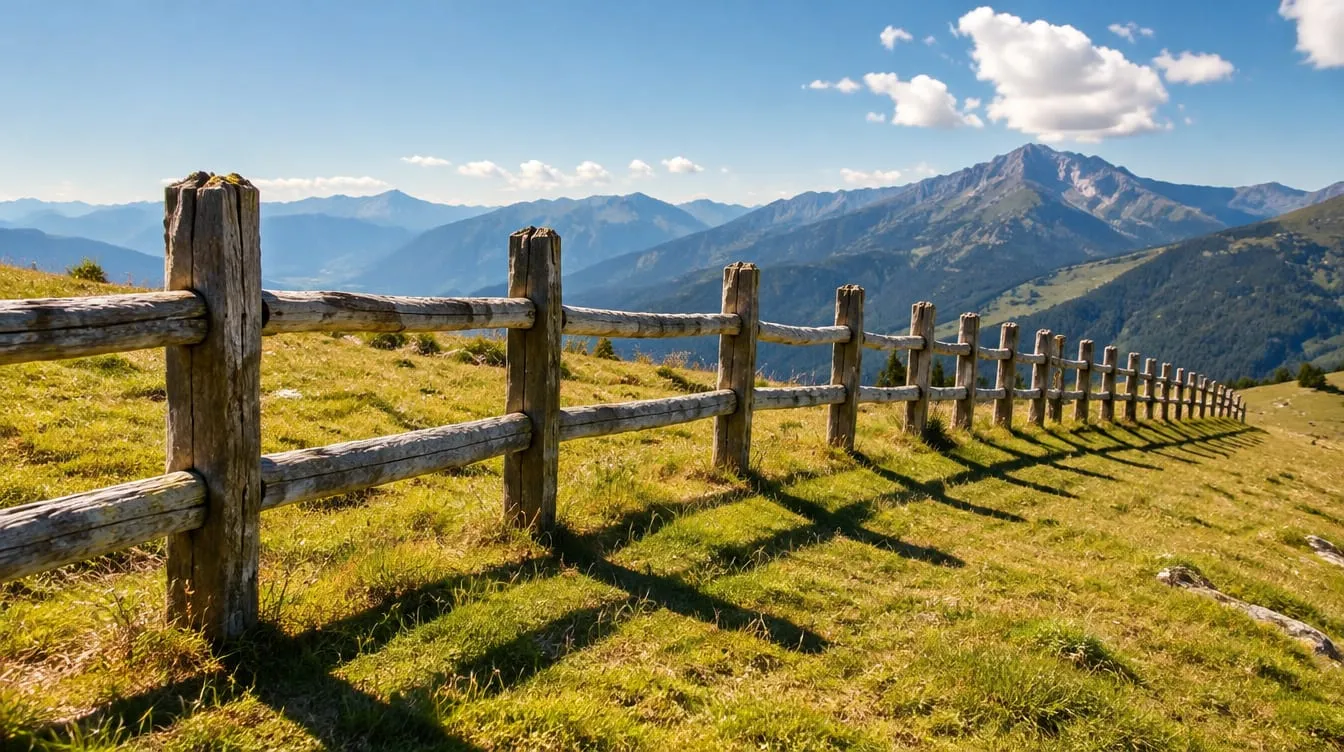
The cover of this article shows the simplest case: full sun, a dark crisp shadow behind every post, bright highlights on the wood. No doubt about it: hard light.
Is golden hour light soft?
It depends on the day, and sources disagree on how to classify it. Photography Life calls it debatable: in general the sun is more diffused when it is lower, but that depends on how clear the atmosphere is. Other guides credit the atmosphere acting as a diffuser, but geometry adds a detail that often gets lost.
A low sun has practically the same angular diameter as a high one: about half a degree. What changes is the length of the shadows. The longer the shadow, the farther the rays have traveled between the object and the ground, and by the one-hundredth rule the more its edge blurs. That is why, with a low sun, the shadow of a pole is dark near its foot and grows paler and softer toward its tip.
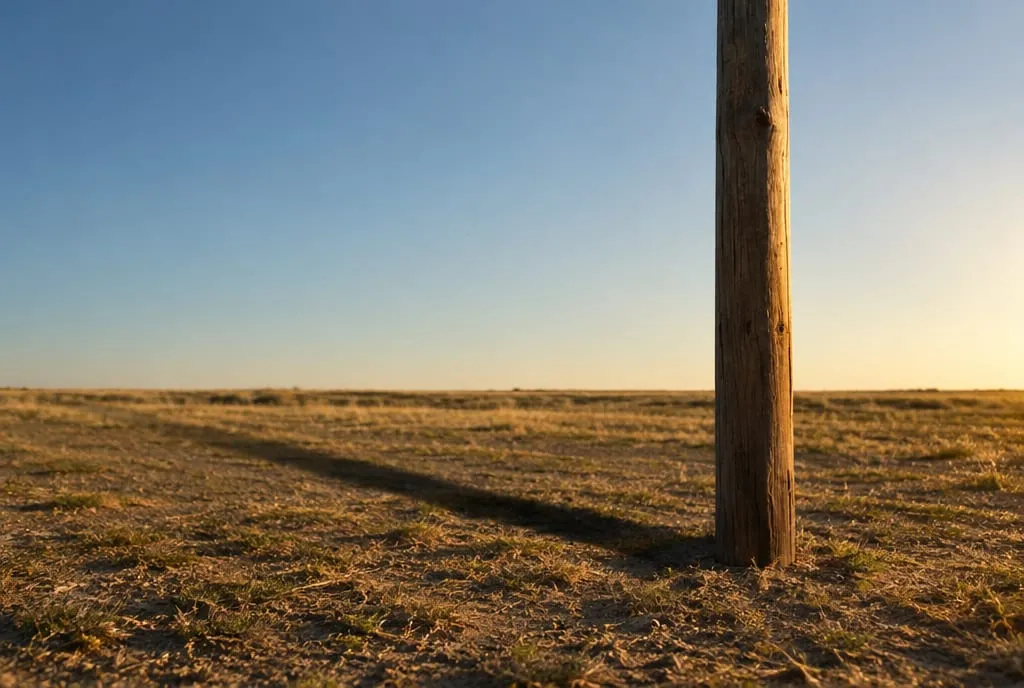 With a low sun the shadow is dark near the foot of the pole and blurs toward the tip, where the rays have traveled farther. Image generated to illustrate the concept, not a shot of a real place.
The practical result: golden hour light is less aggressive than noon light, but it does not become soft like an overcast sky, because the source is still a small disc. Shadows are long, directional and still easy to read. We go deeper in golden hour photography. Blue hour, once the sun is down, really is soft light: the source is the whole sky (blue hour photography).
When should I use hard light and when soft light?
Choose by what makes the subject interesting. Hard light favors form, texture and contrast; soft light favors tones, colors and delicate detail.
| Subject | Light | Why |
|---|---|---|
| Rocks, walls, sand, architecture | Hard and skimming | Wikipedia: on a rough surface, angled hard light accentuates texture and three-dimensionality |
| Dramatic landscapes | Hard | Photography Life: suited to bold landscapes |
| Portraits, macro, still life | Soft | Lighter shadows and softened imperfections |
| Forests, moss, streams | Soft | Low contrast holds detail across the whole frame |
| Silhouettes and graphic lines | Hard | Crisp shadows become shapes |
A caution on the “Why” column: these are tendencies, not rules. A rock shot under an overcast sky can work if you focus on form rather than texture, and hard light can work in portraiture if you want an intense image. What matters is that the choice is yours.
How do I expose in hard light?
Expose for the highlights and watch the shadows. Hard light often has more contrast than the sensor can record in one shot, so you have to decide what to sacrifice.
- Check the histogram right after the shot. Data piled against the right edge: blown highlights, which cannot be recovered. Data piled against the left: blocked shadows.
- Underexpose slightly and lift shadows in RAW. A dark shadow can be opened up at the cost of some noise; a blown highlight is gone for good.
- Change position before you change settings. With the sun to the side or behind you, contrast inside the frame is lower than when you shoot toward the sun.
- Use shadows as the subject. In hard light a shadow can be the main shape; if the big shadows get in the way, frame a detail that does not contain them.
How do I soften the light I have?
You have three levers, in order of simplicity: move the subject, wait, or put something in between. All of them work by enlarging the source as seen from the subject.
- Open shade. The subject is lit by the whole sky, not by the sun alone. It works for portraits and details, even on a clear day, but sky light is cooler, so check your white balance.
- Wait for a cloud. A cloud covering the sun is nature’s softbox, as Wikipedia puts it. If it only passes beside the sun, the shadows stay crisp.
- Add a diffuser. A translucent curtain in front of a window, a diffusion panel, an umbrella. This works for small subjects: a flower, an object, a face. For a landscape you cannot modify the light: you wait for it or change subject.
To harden light, do the reverse and shrink the source. A bare flash is far harder than a diffused one, and so is a small point lamp.
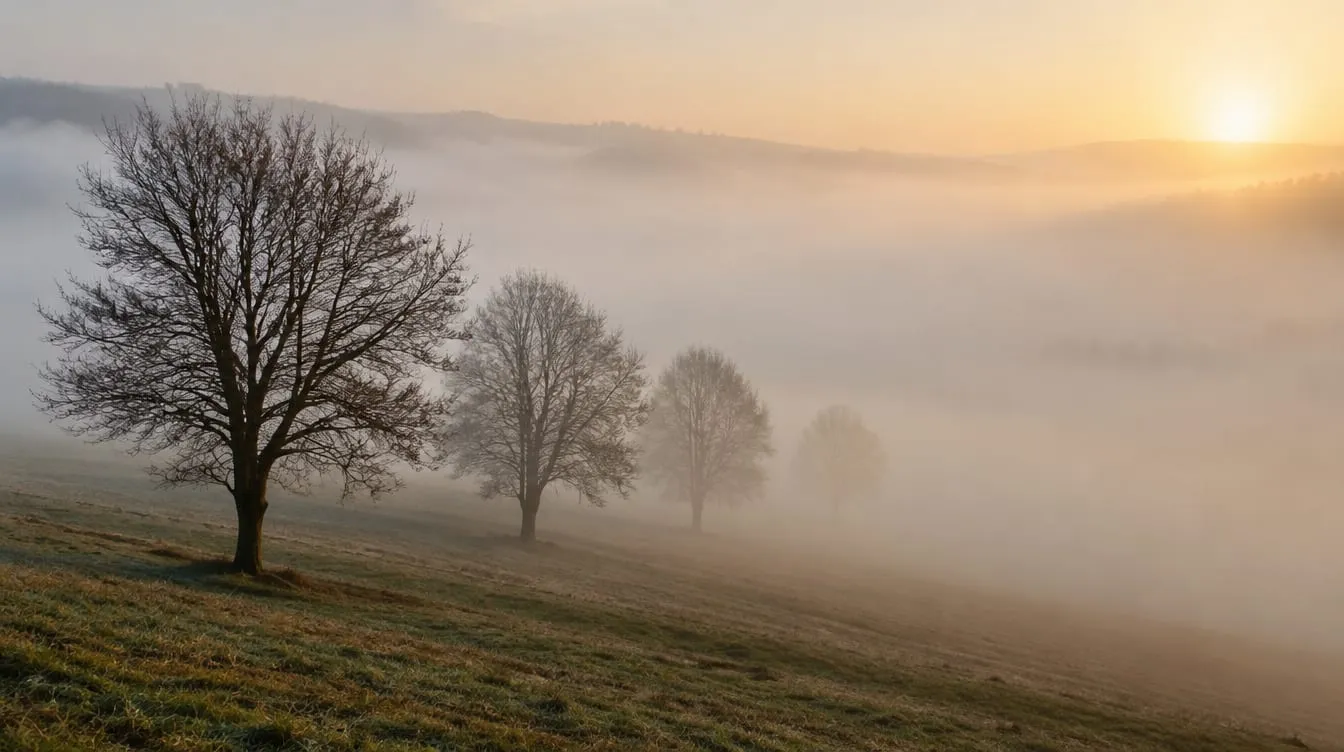
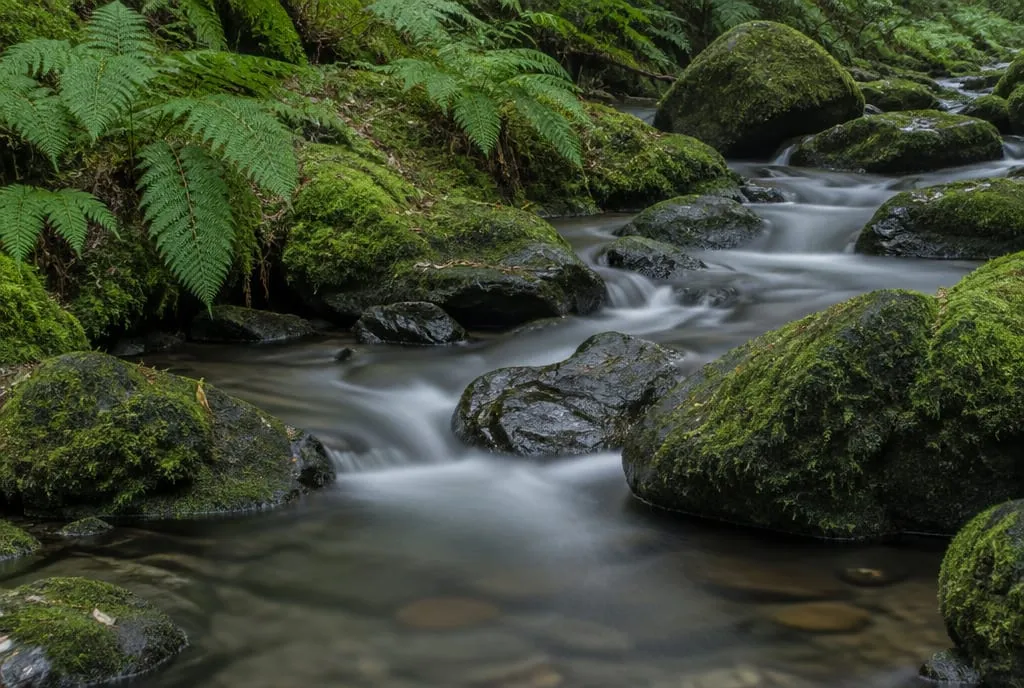 Under an overcast sky there are no cast shadows and tones stay close together: moss and stone keep color and detail with no blown areas. Image generated to illustrate the concept, not a shot of a real place.
Is soft light always flat light?
No: soft does not mean flat. What flattens a photo is mostly direction, not hardness. Soft light coming from the side, like window light, shapes a face with gradual transitions; uniform soft light from above, like an overcast sky, leaves few depth cues.
If your photos look flat, check where the light comes from and how much contrast it has before blaming the fact that it is soft: the causes are in why your photos look flat. Under an overcast sky it helps to include very little of that white, uniform sky and focus on the subject and its detail.
How does Framia evaluate this?
Light is one of Framia’s six categories, alongside composition, optics, color, storytelling and technique. It gets a score from 0 to 100 with an explanation of what works and what does not. If you wonder whether the light in your photo was a choice or an accident, the score is a second opinion to compare with your own reading.
What to do next
A one-afternoon exercise with a ruler and a pen, to test the one-hundredth rule and train your eye for hardness.
- Go out on a day with full sun and find a wall or a sheet of paper facing the sun, so the rays hit it nearly head-on.
- Hold the pen parallel to the wall at 30 cm, then 60 cm, then 1 m. Each time, measure with the ruler the width of the blurred band at the shadow’s edge.
- Note the three values. In full sun the blur should be close to one hundredth of the distance, so about 3 mm, 6 mm and 1 cm. If it is much larger, haze or a thin veil of cloud is softening the light.
- Photograph the same wall or a nearby object twice, with the same framing: in direct sun and in open shade.
- Compare the two shots as thumbnails. Where are the shadows? Which textures read better? Write one sentence on which light you would use for this subject and why.
For a second opinion, upload your favorite shot to Framia and look at the light score. If you want to see how a photo is judged across every criterion, read how to tell if a photo is good.
FAQ
Is hard light always direct sunlight?
No. The sun is the most common example, but any light from a source that is small relative to the subject is hard: a bare flash, a small lamp, a beam of sun coming through a gap. The same sun turns soft once you filter it through a cloud, a curtain or a diffuser.
Does a clear sky always mean hard light?
Only where the sun hits directly. In open shade the subject is lit by the whole sky, which is an enormous source, so the light is soft even on a cloudless day. That is why portraits on sunny days are shot in shade, though that light is often cooler in color, so check your white balance.
Why are shadows still sharp at noon when there are a few clouds?
As long as the sun's disc is uncovered, the source is still small. A cloud only softens the light when it covers or veils the sun; if it passes beside it, the shadows stay crisp. A thin veil makes shadows blurrier but does not remove them.
Can I soften sunlight without any gear?
Yes, three ways: move the subject into open shade, wait for a cloud to cover the sun, or put something translucent between sun and subject, such as a light curtain in front of a window. The larger and closer the material is to the subject, the softer the light gets.
Which light should I pick if I am not sure what to shoot?
Look at the subject, not the sky. If its appeal is form and texture (rocks, walls, sand), look for hard, side-on light. If it is soft tones and delicate detail (moss, flowers, faces), look for soft light. If the right light is missing, change subject before you change settings.