Focal Length Explained: Perspective and Choosing a Lens
 by Marco Carotenuto · · 12 min read
Most people choose a focal length by twisting the zoom ring until the subject fits. It works, but it leaves the most important decision to chance: how big the background looks next to the subject, how far apart the layers of the scene feel, whether a face looks natural or stretched. Focal length doesn’t decide that part. Where you stand does.
This guide covers what focal length is, how much of the scene each focal length takes in, why wide-angle and telephoto lenses seem to change perspective (and what is really going on), what a crop sensor changes, and a three-question method for picking a lens. At the end there is a 30-minute exercise you can do with a single zoom.
What is focal length?
It is an optical distance, in millimeters, between the optical center of the lens and the sensor, measured with the lens focused at infinity. Canon describes it as the distance between the sensor plane and the lens’s nodal point, the point where the light rays converge on their way to the sensor.
Three things are worth clearing up right away, because they cause most of the confusion:
- It is not the physical length of the lens. Canon cites two of its 50mm lenses that measure about 60mm and 115mm long: same focal length, very different barrels.
- It belongs to the lens, not the camera. A 50mm is a 50mm on any body. The only thing that changes is how much of its image the sensor records, as you will see below.
- It is not your distance to the subject. Some guides fold subject distance into the definition, and that is wrong. Subject distance matters enormously, but it is a separate variable, and it is the one that controls perspective.
In practice, focal length tells you two things: how wide the angle of view is and how much objects at a given distance are magnified. The longer it is, the narrower the angle and the bigger the subject.
How much does each focal length see? An angle-of-view chart
Every time you double the focal length from the same spot, the subject appears twice as large and the angle of view shrinks by roughly half (almost exactly half only at long focal lengths). We calculated this chart with the angle-of-view formula for a rectilinear lens, using the full-frame sensor diagonal of about 43mm. The APS-C column shows the focal length you need on a 1.5x crop sensor for the same angle.
| Focal length (full frame) | Diagonal angle | Same angle on 1.5x APS-C | Category | Typical uses |
|---|---|---|---|---|
| 14mm | 114° | 9mm | ultra-wide | interiors, architecture, big skies |
| 24mm | 84° | 16mm | wide | landscapes with foreground, rooms |
| 35mm | 63° | 23mm | moderate wide | street, travel, documentary |
| 50mm | 47° | 33mm | normal | everyday, environmental portraits |
| 85mm | 29° | 57mm | short telephoto | portraits |
| 200mm | 12° | 133mm | telephoto | landscape details, sports, wildlife |
| 400mm | 6° | 267mm | super telephoto | wildlife, birds, distant sports |
The boundaries between categories are not fixed. Canon puts wide angles up to about 35mm and telephotos from about 85mm, while Cambridge in Colour calls 35-70mm “normal” and 70-135mm “medium telephoto”. The uses are rough guides too: as Cambridge in Colour points out, plenty of landscape photographers use telephotos for distant scenes.
Does focal length change perspective?
Not directly: perspective only changes when your position relative to the subject changes. This is where technical sources are clearest. Cambridge in Colour says that, strictly speaking, perspective only changes with your location relative to the subject, and Wikipedia’s entry on perspective distortion adds that two shots of the same scene from the same distance have identical perspective geometry, whatever lens you use.
Picture it this way: shoot the same scene from the same spot with a 24mm and a 100mm, then crop the 24mm frame until it shows the same slice of the scene. The two images have the same proportions. Resolution changes; the size relationship between subject and background does not.
So why does everyone say wide angles “stretch” distance and telephotos “compress” it? Because focal length pushes you to stand in a particular place. If you want the same subject at the same size in the frame, a wide angle makes you move closer and a telephoto makes you step back. That move is what changes perspective. Focal length affects it indirectly, by deciding where you shoot from.
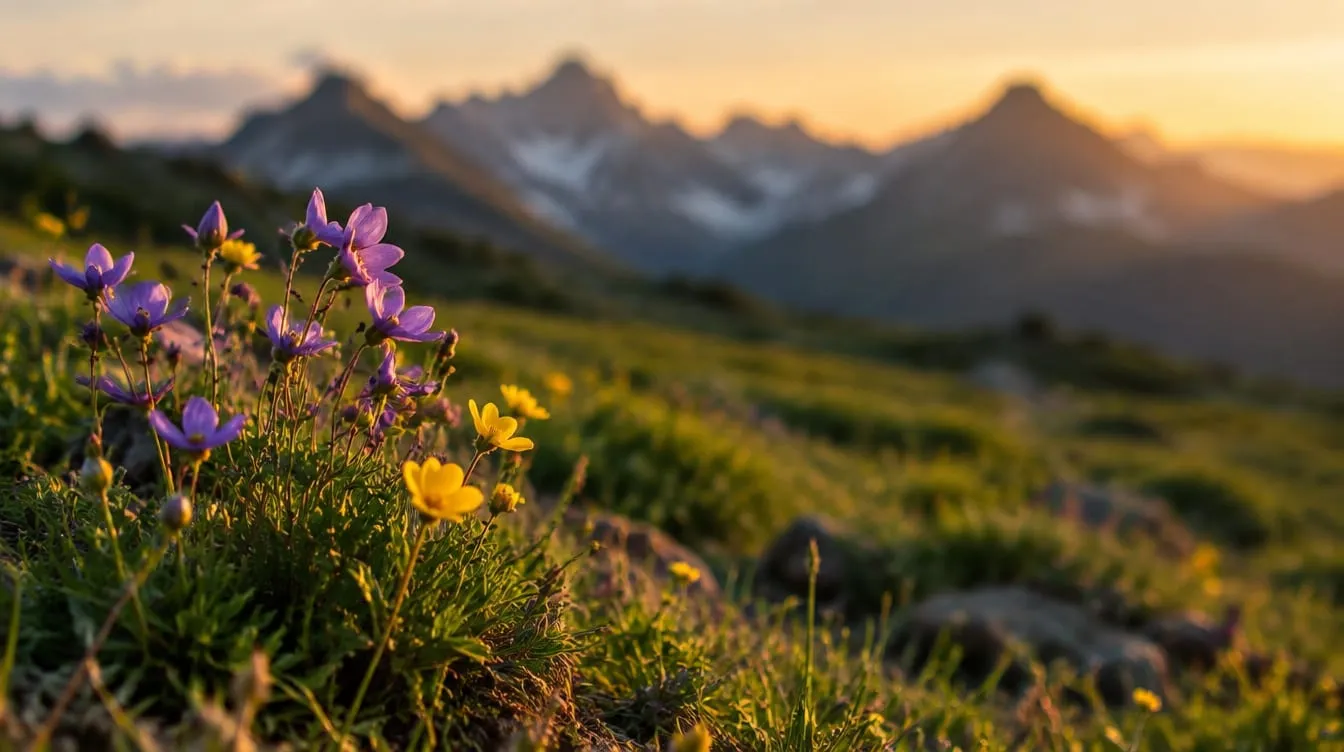
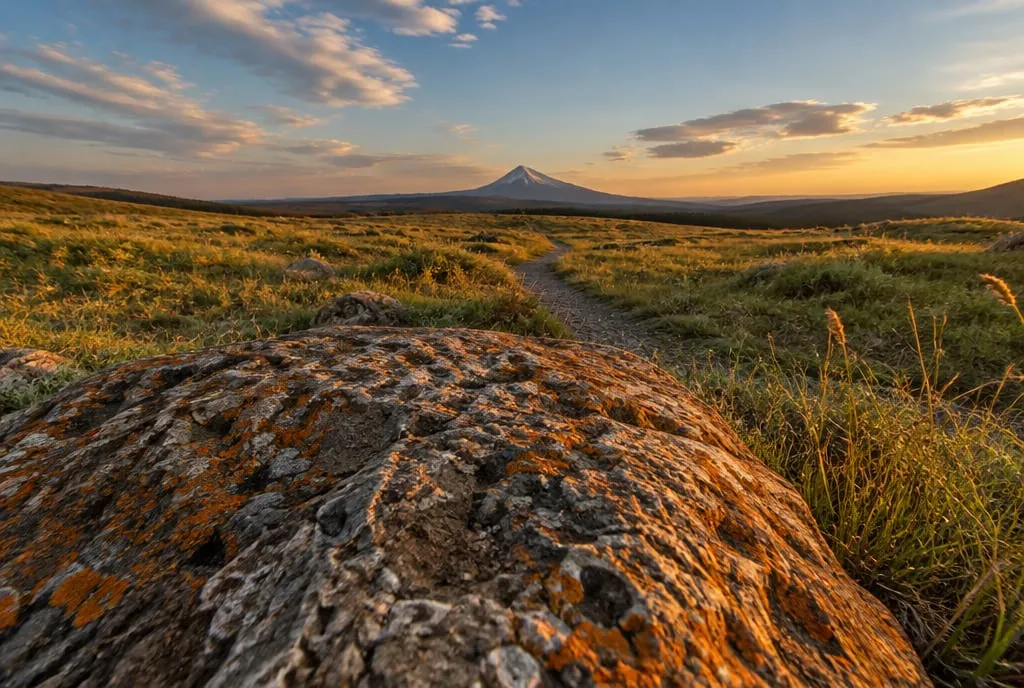 A wide angle from very close to the boulder: the foreground looms huge, the mountain shrinks to a dot, and the gap between them feels endless. Being close to the boulder is what creates the effect. Image generated to illustrate the concept.
The rule behind it is simple: an object’s apparent size depends on its distance from you. If you are 3 feet from a rock and 3 miles from a mountain, stepping 18 inches closer doubles the rock and leaves the mountain practically unchanged. That is why a wide angle used up close exaggerates the foreground. It isn’t the lens; it’s how close the lens lets you get while still fitting the whole scene in.
What is telephoto compression?
It’s the effect where, with a telephoto used from far away, the background looks huge and pressed right up against the subject. Again, distance is the cause: when you are far from both subject and background, the gap between their two distances matters less, so the background looks much bigger next to the subject than it does from up close.
Let’s put numbers on it. A chapel on a hill, with a mountain 10 kilometers (about 6 miles) behind it:
- From 1 km away from the chapel, the mountain is 11 km from you. The ratio between the two distances is 11.
- From 50 meters away from the chapel, the mountain is 10.05 km away. The ratio is about 200.
Apparent size is inversely proportional to distance. So, relative to the chapel, the mountain looks roughly 18 times larger from far away (200 divided by 11) than from up close. From 1 km you need a telephoto to make the chapel big enough in the frame; from 50 meters a wide angle will do, but the mountain becomes a small detail in the background.
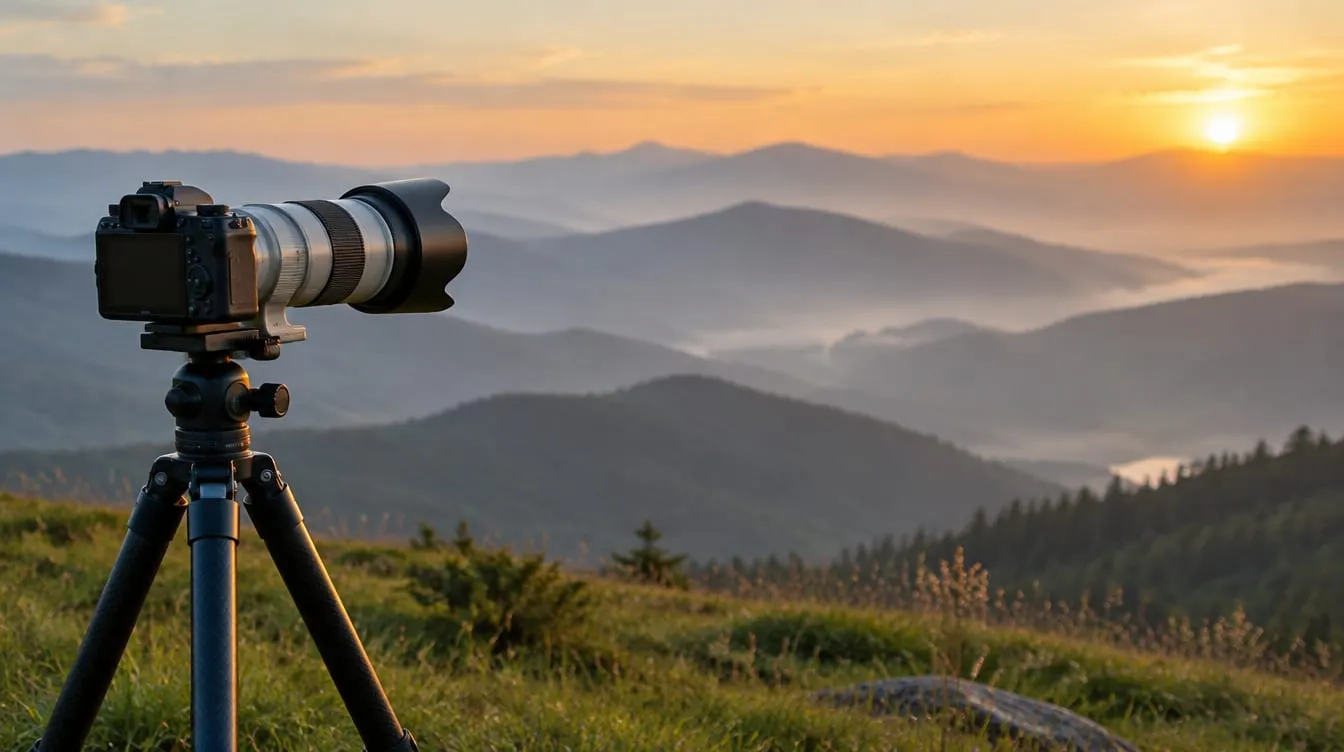
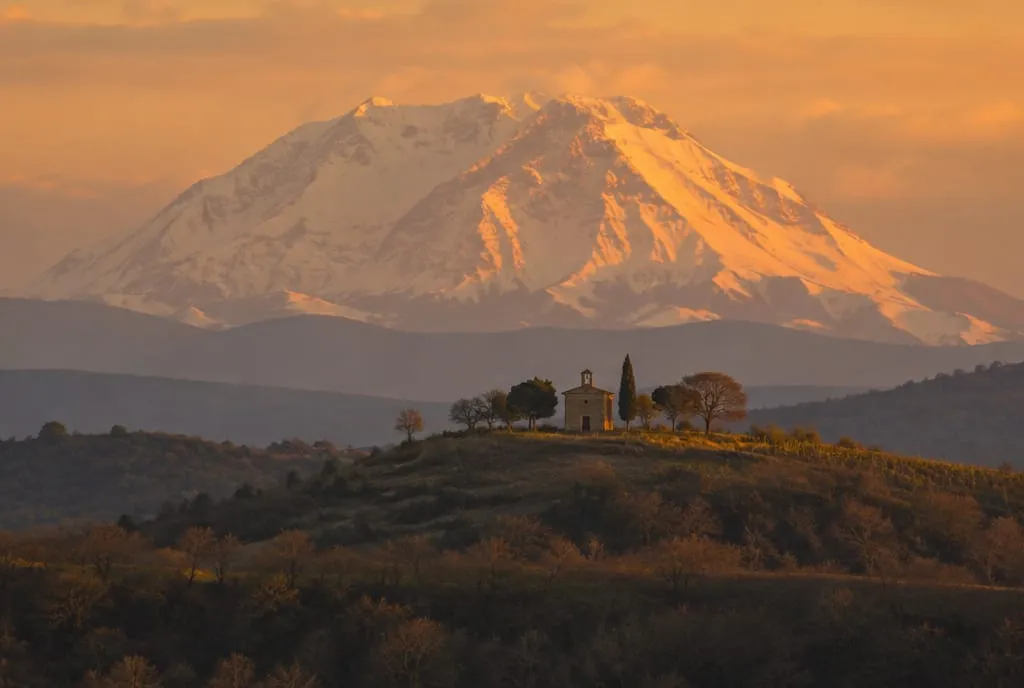 A telephoto from a distance: the mountain seems to tower right behind the chapel, even though it is much farther back. The layers close up because the photographer is far from both. Image generated to illustrate the concept.
Wikipedia calls these two effects extension distortion (wide angle up close) and compression distortion (telephoto from afar), and notes that both are used on purpose: the first to give weight to a nearby element, the second to make distant objects look close together. On our photo tours we often see the real leap happen when people stop zooming from where they stand and start walking to choose how the layers relate.
Why do wide-angle lenses distort faces and buildings?
For two different reasons, and it helps to keep them apart.
Faces distort because of distance. To fill the frame with a face using a wide angle you have to get very close, and at that distance the nose is noticeably nearer to you than the ears: it looks bigger, while the ears shrink. Wikipedia notes that perspective distortion is particularly noticeable in portraits taken with wide-angle lenses at short distances. That is why tight portraits are usually shot with a short telephoto: not because an 85mm “flatters”, but because it puts you at a distance where features stay in proportion.
Buildings “fall backward” when you tilt the camera up. Vertical lines converge at any focal length when the sensor isn’t parallel to the facade; with a wide angle, Wikipedia explains, they converge more because the field of view is wider. The fix is to keep the camera level (and crop the bottom later if needed) or correct it in editing.
Then there is optical distortion, which is something else again: a lens flaw, such as straight lines bowing outward near the edges (barrel distortion). Cambridge in Colour lists it among the aberrations every lens shows to some degree, and many raw editors correct it with lens profiles. It doesn’t depend on distance, and it isn’t perspective.
What changes with an APS-C or Micro Four Thirds sensor?
The angle of view changes; the focal length and the perspective don’t. A smaller sensor records only the center of the image the lens projects, so the framing tightens as if you had zoomed in. To compare formats you use the crop factor:
- Canon APS-C: 1.6x. A 50mm frames like an 80mm on full frame, which is the example Canon gives.
- APS-C from most other brands: 1.5x. A 16mm frames like a 24mm.
- Micro Four Thirds: 2x. A 25mm frames like a 50mm.
People talk about “equivalent focal length”, but it is shorthand: a 50mm on APS-C has the angle of view of an 80mm on full frame, it doesn’t become one. From the same spot, perspective is the same as cropping a full-frame shot. Phones also list their cameras in full-frame equivalent focal lengths, so you can compare them with a camera’s.
Does focal length affect blur and depth of field?
Yes, both, which is why picking a focal length isn’t only about framing.
Camera shake. A long focal length magnifies small hand movements too. The rule of thumb that Cambridge in Colour gives is that, handheld, your shutter speed should be at least 1 over the equivalent focal length: at least 1/200 s with a 200mm on full frame, and at least 1/300 s with the same lens on a 1.5x APS-C body. It’s rough guidance, and image stabilization shifts it. Causes and fixes are in why are my photos blurry.
Depth of field. At the same distance and aperture, a longer focal length gives a shallower zone of sharpness. If instead you step back with the telephoto to keep the subject the same size, depth of field on the subject stays similar, but the background looks blurrier because it is magnified more. It is also why hyperfocal distance grows so quickly as you zoom in: with a wide angle it is easy to get everything sharp, with a telephoto it isn’t. You can see it in the numbers in our hyperfocal distance guide.
How do you choose the right lens for a shot?
Answer three questions, in this order. It is the method we use so perspective isn’t left to chance.
- What relationship do I want between subject and background? If the background should look big and looming, you need distance; if it should be a wide, far-off setting, you need to be close to the subject.
- Where do I get that relationship? Move until you can see, by eye, the right proportions between the layers. This is choosing your perspective.
- Which focal length frames the subject from there? Only now do you turn the zoom, or pick a lens, to crop the frame the way you want.
| What you want | Where you stand | Typical focal length (full frame) |
|---|---|---|
| Dominant foreground, deep landscape | Very close to the foreground, often low | 16-24mm |
| Huge mountain behind a small element | Far from both | 100-400mm |
| Tight portrait with natural features | A few meters from the person | 85-135mm |
| Person in their surroundings | Close, inside the scene | 28-50mm |
| Isolated detail in a wide landscape | Where you are, unable to get closer | 70-200mm |
| Whole building without converging lines | Far enough to keep the camera level | depends on space: 24-50mm |
If the foreground matters to you, foreground in landscape photography covers how to pick one and how close to get. And if you shoot with a single zoom, keep in mind what Cambridge in Colour says: a zoom doesn’t mean you no longer have to move, it just adds flexibility. With a prime, on the other hand, you have to walk to change the framing, which is often good training.
Zoom or prime lens?
It depends on what you need more: flexibility, or a brighter, lighter lens. A zoom lets you reframe without changing lenses, which helps when the scene is moving or you can’t move. Primes, according to both Canon and Cambridge in Colour, are generally smaller and lighter, have wider maximum apertures; Cambridge in Colour adds that an inexpensive prime can match or beat the image quality of a high-end zoom. It also notes, though, that recent high-end zooms show no noticeable quality loss except to a trained eye or in very large prints.
One simple trick for learning perspective: tape your zoom at a single focal length for a whole outing. It forces you to use your feet, and perspective becomes a deliberate choice instead of a side effect of the zoom ring. How perspective works with the rest of the image is covered in our guide to photography composition.
What to do next
The two-series exercise: half an hour, any zoom (the kit lens is fine) and a subject with a distant background, such as a lone tree in front of a hill or a lamppost in front of a building.
- Series A, same position. Stand about 30 feet (10 m) from the subject and shoot at your widest, middle and longest focal lengths without moving.
- Crop the Series A shots so they all show the same slice of the scene as the longest one. Compare them: the proportions between subject and background are the same; only the fine detail changes.
- Series B, same subject size. At your widest focal length, move closer until the subject fills half the height of the frame, and shoot.
- Step back and zoom in until the subject fills that same half of the frame again. Shoot at the middle and then the longest focal length, matching the size each time.
- Compare Series B. Look at how big the background is next to the subject, how much of the scene fits at the sides, and which version tells the story you wanted.
- Write down the rule you just saw for yourself: in Series A perspective doesn’t change, in Series B it does, because you moved.
If you want an outside opinion, upload your favorite Series B frame to Framia: you get a score and an explanation for each of the six categories, Optics included, and you can see whether your choice of distance and focal length holds up.
FAQ
Does a 50mm lens see like the human eye?
Only partly. Canon notes it is generally accepted that a 50mm gives the closest perspective to human vision, but the field of view is not the same: our central vision covers roughly 40-60 degrees, with much wider peripheral vision around it. The geometric reason is different: a full-frame sensor's diagonal is about 43mm, and a lens with a focal length close to the diagonal is called a normal lens.
Is digital zoom the same as optical zoom?
No. Optical zoom actually changes the focal length; digital zoom crops the center of the image and enlarges it by interpolation, as Cambridge in Colour explains. Perspective is identical, because you have not moved, but you lose resolution. Phones work the same way: switching to another rear camera is optical zoom, pinching beyond that is digital.
What do numbers like 18-55mm or 70-200mm on a lens mean?
They are the zoom's shortest and longest focal lengths. An 18-55mm runs from moderate wide angle to short telephoto on APS-C; a 70-200mm covers the medium telephoto range. The number that follows, such as f/3.5-5.6, is the maximum aperture, which on many zooms gets smaller as you zoom in.
Does a crop sensor turn a 50mm lens into an 80mm?
No, it stays a 50mm: focal length belongs to the lens. What changes is the framing, because the smaller sensor records only the center of the image. On a Canon APS-C body (1.6x crop) a 50mm frames like an 80mm on full frame. From the same spot, perspective is exactly the same.