Photo Feedback: Forums, Facebook Groups or AI? How to Choose
 by Marco Carotenuto · · 9 min read
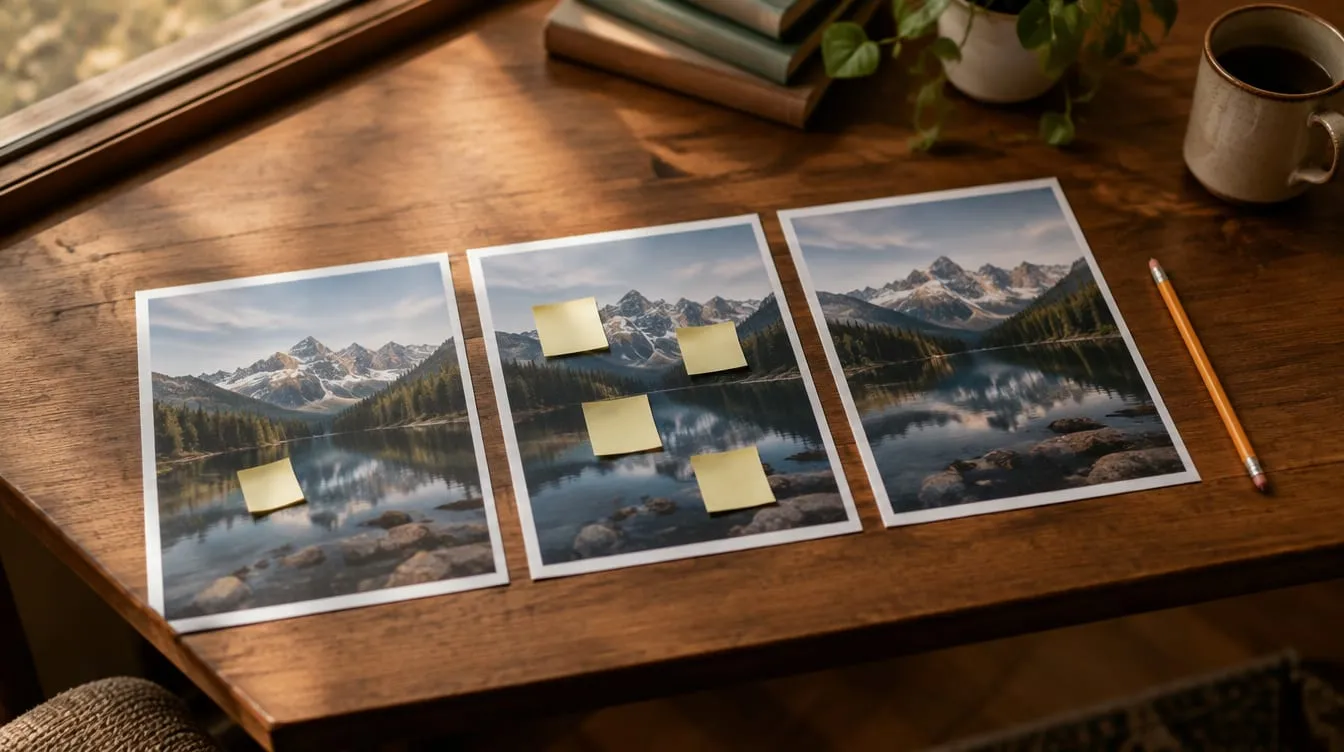
You have a photo you’re not sure about and you want an honest opinion. The first hurdle is where to ask: a Facebook group, a forum, a camera club, a paid service or an AI analysis. Every one of them promises photo feedback, and every one delivers something different.
This guide doesn’t rank the best sites. It helps you pick the right source for the question in your head, and spot in advance where each one tends to fall short. If you first need a yardstick for judging a shot, start with how to tell if a photo is good; and for writing a request that draws useful answers, there’s the four-line brief in photo critique: how to ask for it and actually use it.
Where can you get feedback on your photos?
There are five main routes, and none is the best in every case. The table sums up what each gives you and where it falls short. The ratings are ours, drawn from the photographers’ accounts quoted below and from what we see following many photographers in the field, not from a measurement:
| Source | Where it works | Where it falls short |
|---|---|---|
| Forums and genre communities | Reasoned answers from people who shoot your genre (landscape, street, portrait) | Few participants, slow replies, sometimes no reply at all |
| Social media groups | Many eyes quickly; good for seeing how a general audience reacts | Often only compliments or jokes; replies can depend more on your network of contacts than on the photo |
| Camera club or workshop in person | You can explain your intent and answer questions; the critic adapts to your level | Takes time and sometimes money |
| Paid critique | Dedicated attention on your photo, usually from someone expert in the genre | Cost; the critic may be too kind if they want you back |
| AI analysis | Instant, at any hour, repeatable on the same photo | Doesn’t know your intent and tends to score generously |
Why is online feedback so often useless?
Because it’s usually a reaction, not an analysis. The people replying don’t know what you were going for and have no reason to stick their necks out. Photographers describing their own experience say it in different ways.
In a DPReview forum thread where someone asks where to find constructive critique, one participant observes that most comments on forums are plain approval even when the photo clearly needs fixes, and another notes that the forum’s general policy is not to critique unless asked. A third, who uses the Fred Miranda critique forum, says that people who ask for input often defend their work, argue or explain away the faults, then disappear after that one post. A Photo.net thread from 2013 (old, but the complaint hasn’t changed) has members saying that most replies are “nice shot” or a reminder of how someone else would have framed it.
The common thread: the problem is rarely the channel. It’s a request that doesn’t say what you want to know, plus a habit of answering with approval to be polite.
Do you want to fix this photo or train your eye?
Before choosing a source, decide what you’re after: fixing this shot, or getting better at the next ones. One DPReview reply puts it well: feedback can improve an image, while improving your skills takes study and exposure to other people’s work. They’re different goals and need different sources.
A practical rule: one question, one source. Write the question first, then pick who can answer it:
| Your question | Best-fit source | Why |
|---|---|---|
| “Is there a technical flaw I can’t see?” (horizon, exposure, focus) | AI analysis, or anyone with a grid | These are checkable facts |
| “How do strangers react at first glance?” | Social group, forum | You want the non-expert audience |
| “Does the idea come across?” | Camera club, an experienced person | You need someone you can explain the intent to |
| “Which photo from the set do I pick?” | An experienced person, then AI as a second look | Coherence and story matter |
| “Which criterion should I train most?” | AI analysis across several photos | The lowest recurring criterion is the habit to fix |
Which comments can you check without trusting anyone?
The ones that describe a fact about the picture: a tilted horizon, a blown sky, an edge cutting through a subject. Whoever says it, forum or AI, you can check it yourself in thirty seconds. They are also the most valuable comments because they don’t depend on the taste of whoever replied.
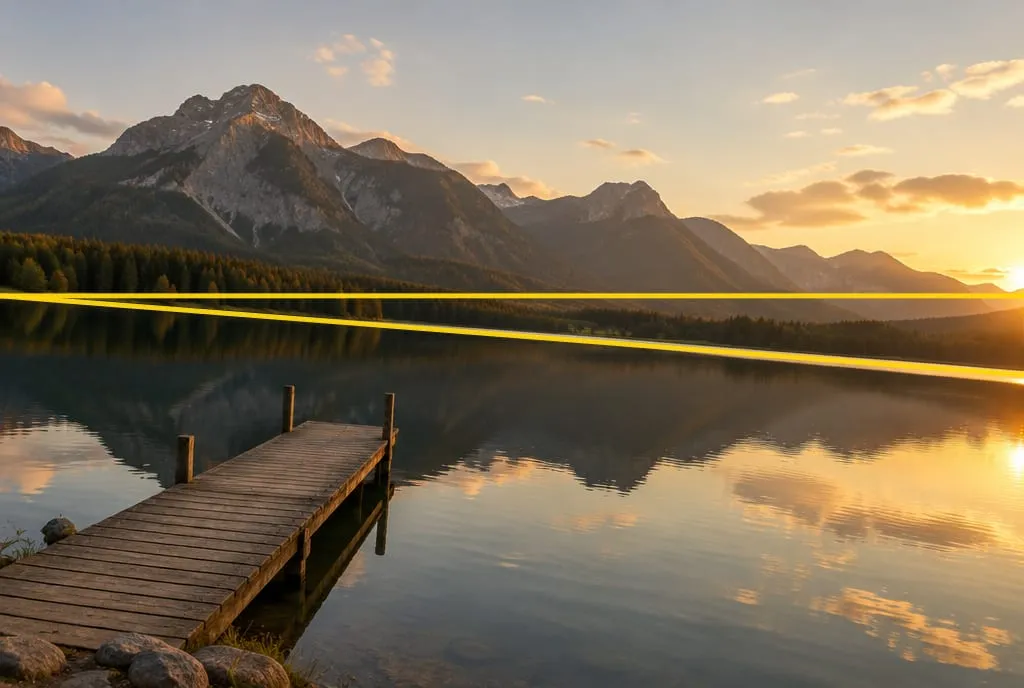 A checkable fact: the far edge of the lake, which in this scene should run level, drops to the right by about four degrees. One line is enough to confirm it. Image generated to illustrate the concept.
For a comment like this the test is simple: draw a line, look at a thumbnail or switch on the grid. If the fact is there, fix it. For a tilted horizon, the most common case, the details are in where to put the horizon in a photo. If it isn’t there, you’ve learned the person replying was looking casually, and you can weigh their other comments accordingly.
How do you use forums and groups without wasting time?
With precise requests and few photos. Three habits make the difference:
- Find the group for your genre. A landscape group gives you a view on landscape; a general group gives you an average of different tastes. On DPReview, one member advises posting in the forum for your genre rather than the one for your camera brand.
- Ask what they would change. “What would you remove or move?” invites an answer; “thoughts?” invites a compliment. Add your doubt and your intent, as in the brief described in photo critique.
- Comment on other people’s photos. Communities run on reciprocity: an old Photo.net thread recalls that on some critique sites you were expected to give three critiques for every photo you posted. Commenting precisely also trains your eye, because explaining what doesn’t work in someone else’s photo is one of the quickest ways to spot it in yours.
When the comments arrive, say thanks and don’t defend the picture. People who spend time on a critique aren’t looking for an argument, and arguing or justifying each flaw is exactly what, according to the Fred Miranda user quoted above, makes the conversation die. A clarifying question, on the other hand, helps you understand what the other person saw.
When is a camera club or an in-person critique worth it?
When your question is about intent, choosing between photos in a set, or your progress over time. In person you can explain what you were after, look at the print together and answer objections, all things that get lost online. One DPReview reply sums it up: the member joined a camera club that meets in person to analyze images and calls it the most efficient way in their experience.
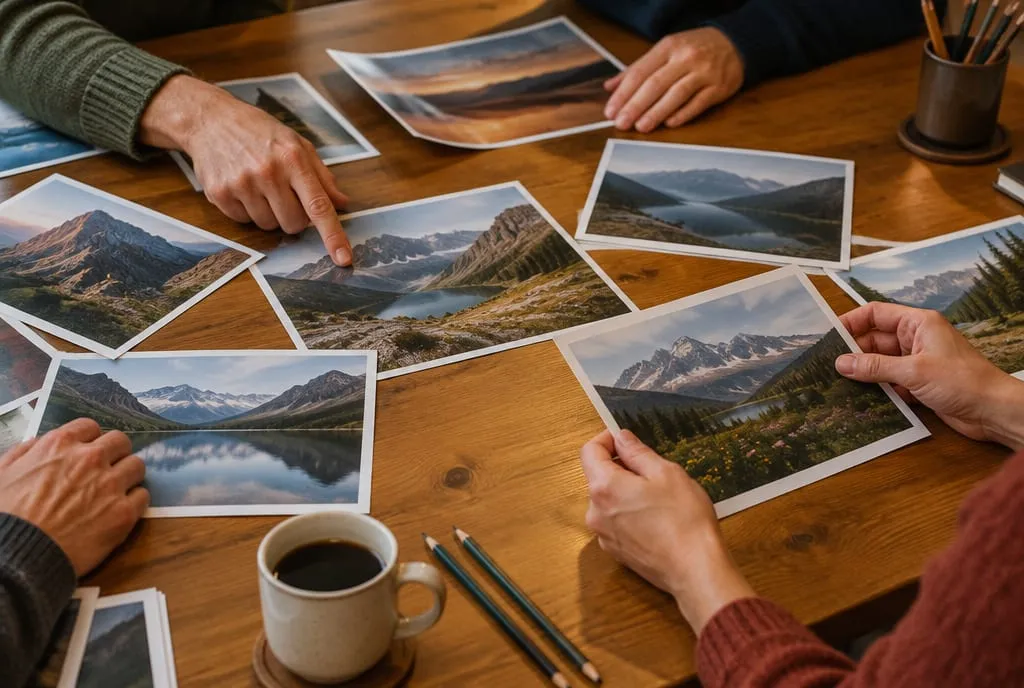 A club evening: prints on the table, hands pointing at a spot, questions about intent. It’s the context online feedback can’t recreate. Image generated to illustrate the concept.
The limit is practical: a club has schedules and costs, and the level depends on who attends. If you want the view of someone expert in your genre, a paid critique can work on one condition: ask for the flaws too, not only the strengths. People selling the service have a reason to leave you happy, and a DPReview user who has tried several suggests asking them to pick out your best photos as a way around that tendency to be too positive.
When does AI make sense, and when doesn’t it?
It makes sense for checkable facts and for comparison, where you need a constant yardstick. It’s available at any hour, you can repeat the analysis on the same photo and compare it with yesterday’s, and it has no social reason to be nice to you. But it doesn’t know your intent and it leans towards generous scores. How to use it without being fooled is covered in AI photo analysis: what it sees and how reliable it is, with three checks you can run in ten minutes.
Framia works in this space: it gives a score and an explanation for each of the six criteria (composition, light, optics, color, story, technique) and flags your weakest category. It’s useful as a first filter and for writing the “doubt” you take to a person, not as a replacement for a conversation about intent. If you’re still looking for the right tool, the best apps to improve your photography compares the alternatives.
How many sources should you use for the same photo?
Two or three, no more. More opinions don’t mean more clarity: in the DPReview thread, one photographer describes collecting several critiques on a portfolio, including two one-to-one sessions, and ending up confused and demoralised by the contradictory advice. The warning is simple: all opinion is subjective, and many opinions together cancel out.
The filter is a single rule. Keep the comments that point to a specific spot in the photo, explain the effect it has, and say what to check or change. The rest is reaction. If the same spot comes up from two different sources, treat it as a fact worth acting on, even if neither source explained it well.
What to do next
A 30-minute experiment to find out which source works best for you, using a recent photo:
- Pick one photo and write the question you want settled, in one line (“does the eye land on the subject?”, “is the light flat?”).
- Show the same photo with the same question to three different sources: for example a group or forum, a person you trust and an AI analysis.
- Copy every comment into a table with three columns: source, comment, actionable (yes/no).
- Mark “yes” only if the comment points to a spot in the photo, explains the effect and says what to change or check.
- Count the “yes” answers per source, and check with a line or a thumbnail the ones that describe a fact.
- Note the source that gave you the most actionable comments: for this kind of question, that’s the one to use next time.
If you’d like to add an analysis by criteria, upload the photo to Framia and compare its lowest criterion with the one you wrote at step 1: where they match, you’ve found the first thing to work on.
FAQ
Is a Facebook group or a forum better for photo feedback?
It depends on what you want. Groups answer fast but, according to people who use them, they tend to reward whoever interacts and often stop at compliments. Genre-specific forums take more patience and sometimes give more reasoned answers. Either way, the quality depends on how precise your question is.
Is an AI photo analysis enough to improve?
It's enough to know where to look, not to decide what to say with the picture. It's repeatable and always available, so it's great for comparing shots from the same outing. For intent and the coherence of a series you still need a person who knows your progress.
Why do I only get compliments?
A generic request ("thoughts?") invites a reaction, not an analysis, and in many communities people worry about sounding rude. Name the spot you doubt and ask explicitly what they would change: the answers get more specific.
Should I pay for a professional critique?
Yes, it can be very useful if the critic knows your genre. Ask for flaws as well as strengths: a person selling the service has a reason to stay kind so you come back, so an explicit request makes a difference.
How many people should see the same photo?
Two or three sources are enough. With many opinions the advice starts contradicting itself and you end up more confused than before: only what comes back from several sources about the same spot counts.