Photo Critique: How to Ask for It and Actually Use It
 by Marco Carotenuto · · 7 min read

You post a photo, type “thoughts?” and get three hearts and a “stunning!”. It feels nice, but you’ve learned nothing. The problem isn’t the people replying. It’s the question, which doesn’t say what you want to know.
A photo critique is useful when it lets you change something in your next shot. This article shows you how to ask for one, who to ask, how to read the comments that come back and how to turn them into a concrete change. If you’re missing a yardstick for judging a photo in the first place, start with how to tell if a photo is good.
What does a photo critique actually mean?
A critique is someone looking at your photo and telling you what works, what doesn’t and why, measured against what you were trying to do. An opinion is a reaction (“I like it”); a critique is reasoning (“my eye jumps to the right because that’s the brightest spot”).
In practice: a reaction tells you how the shot landed, a critique tells you what to change. To get one you have to give the viewer something to work with. Nobody can guess your intent, and without it everyone critiques the photo they would have taken.
How do you ask for a photo critique? The four-line brief
Before you show the photo, write four lines. It takes two minutes and changes the quality of the answers:
- Intent. What you wanted viewers to notice or feel.
- Doubt. The exact spot that isn’t working for you.
- Context. Where it’s going (print, social, portfolio) and what you’re currently trying to learn.
- Off the table. The choices you made on purpose and don’t want reopened.
Here’s the difference between a vague request and one that works:
“What do you think of this landscape?”
“I wanted a calm scene with the larch as the only star. I’m worried the pale rock on the right edge pulls the eye out of the frame. I’m working on composition; the horizontal crop is deliberate. Does the larch hold, or does the rock win?”
The second request names a criterion (composition), a place in the photo (the right edge) and a decision already made. Whoever answers knows where to look, and even a two-line reply is useful.
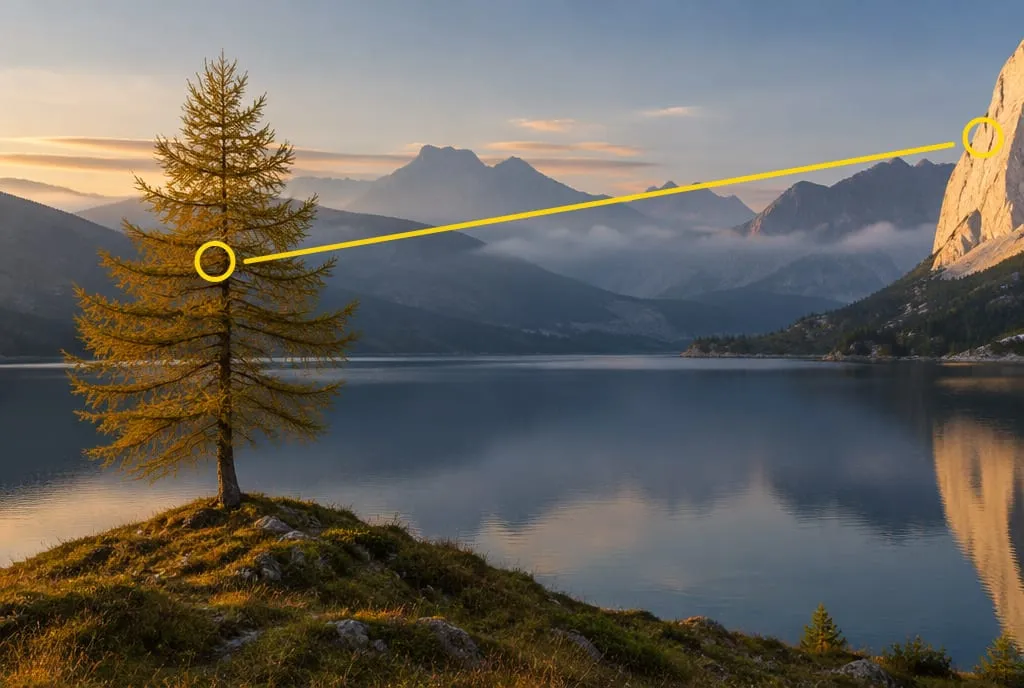 A useful comment points to the spot and the reason: here the brightest area is the rock on the right edge (top circle), so the eye goes there instead of to the larch (left circle). Generated image, made to illustrate the concept.
Who should you ask for a critique?
It depends on what you need right now. Every source gives you something and has a clear limit:
| Who | What you get | Limit |
|---|---|---|
| Friends and family | An honest reaction from a non-expert audience: what hits at first glance | They go easy on you and lack the words for what’s wrong |
| Social media and likes | A hint of whether the photo stops the scroll | Never says why; depends on timing and audience |
| Forums and online groups | Many eyes and quick replies | Conflicting opinions, often taste (“I’d have gone black and white”) |
| Camera club, workshop, a more experienced photographer | Reasoned critique that can follow you over time | Takes time and sometimes money |
| AI analysis | A criterion-by-criterion verdict, always available and repeatable on the same photo | Doesn’t know your intent or the context of that shot |
No single source is enough. One combination that works: use a criterion-based analysis to find the weak spot, then take that spot to an experienced person, who can tell you whether the idea holds. Framia, for example, returns a score and an explanation for each of the six criteria (composition, light, optics, color, story, technique). It’s a good starting point for writing the “doubt” line of your brief, because the intent stays yours.
How do you read the comments you get back?
Before deciding what to do, sort each comment into one of four types. Almost everyone skips this step, and it’s what stops you from wrecking a photo by following the wrong advice.
| Type of comment | Example | What to do |
|---|---|---|
| Verifiable fact | “The horizon is tilted”, “the sky is blown out” | Check it (grid, histogram). If it’s true, fix it |
| Effect on the eye | “My eye runs off to the right” | View the photo as a thumbnail: if you see it too, it’s a real problem. Then decide whether it’s intended |
| Taste | “It’d look better in black and white” | Note it and move on. If many people say it, it becomes information |
| Fix that changes the idea | “Crop tight on the subject” | Keep the problem, drop the fix if it betrays your intent |
The last row is the most valuable. Someone who suggests cropping tight on the subject is almost always saying that something in the background distracts. The problem (“the background distracts”) is real and useful; the fix (“crop”) is one of many and may contradict what you meant to say. Separate them: keep the first, weigh the second.
A practical rule: if two people independently flag the same spot, treat it as fact even if neither can explain it well. If only one person flags it, check it with the tools above before acting.
What should you do when a comment stings?
Wait a day and read it again. An instant defensive reaction doesn’t mean the comment is wrong; it often marks a spot you already suspected. Ask yourself two things: is the comment a fact, an effect or taste? And if it were true, what would change in the photo?
You don’t have to accept every critique. But you should be able to say why you’re rejecting one (“it doesn’t serve my idea”), not just that you dislike it. That way even the critiques you don’t follow help you clarify what you’re doing.
How do you turn a critique into a better photo?
One change at a time, and one you can check. If you fix four things together, you won’t know which one worked. The process is short:
- List the comments and tag each with one of the four types.
- Pick one spot: the one flagged more than once, or the one that touches your weakest criterion.
- Change only that: a new crop, an exposure fix, a return to the location on another outing.
- Compare the two versions a few days later, as thumbnails, before deciding which one you keep.
- Write one line on what you learned: in a few months you’ll see the same spots coming back.
If a problem repeats across many photos, it isn’t a flaw of that shot: it’s a habit. That’s why it pays to show two or three photos from the same outing rather than one. If the recurring flaw is flat light, for example, the guide on why your photos look flat lists the causes to check.
How do you give constructive critique to others?
Describe, explain the effect, ask about intent and only then, if needed, suggest a fix. Giving critique is one of the best ways to train your own eye, and a four-step formula keeps it honest:
- I see…: what’s in the photo, without judging (“the rock on the right edge is the brightest area”).
- It makes me…: the effect on your eye (“my eye goes straight there and doesn’t come back to the larch”).
- What works…: at least one specific success (“the larch is isolated and reads instantly”, not “nice”).
- What were you going for?: the question about intent, before suggesting anything.
Avoid advice that starts with “I would have…”: it describes the photo you’d have taken. And if a fix can no longer be applied to that shot (“I’d have put the tree on the right”), frame it as something to keep in mind next time. A highly voted answer in a Photography Stack Exchange thread draws exactly that line between suggestions the photographer can still act on and ones they can’t.
What to do next
A 30-minute exercise with a recent photo of yours:
- Pick one photo from a week ago and write the four-line brief (intent, doubt, context, off the table).
- Show it, with the brief, to two different sources (for example a criterion-based analysis and an experienced person).
- Copy the comments into a list and tag each one: fact, effect, taste or fix.
- For every fix, rewrite the problem behind it in one sentence.
- Choose one point only, edit the photo (or reshoot it) and put it next to the original as thumbnails.
- Write one line: what changed, and what it told you about your habits.
If you’d like to start from the six criteria, upload the photo to Framia and compare your lowest criterion with the comments you got: where they overlap, you’ve found the thing to fix first.
FAQ
Is harsh feedback more useful than kind feedback?
Not necessarily. Feedback is useful when it is specific and explained: it points at a place in the photo and says what effect it has. Harshness with no reasoning is noise, and kindness with no detail ("love it!") gives you nothing to fix.
What if two people tell me opposite things?
Go back to your intent. Often the two comments are about different parts of the photo and both are true. If they're about the same spot, one of them is usually taste: keep the one that serves the idea of the shot and note the other.
Should I reply to people who critique my photo?
Thank them and, at most, ask questions to understand better. Defending the shot costs you information: if someone missed what you were trying to show, that already tells you how the photo reads on its own.
How many photos should I show at once?
One to three. A single photo gets you feedback on that shot; two or three from the same outing reveal the habits that keep coming back, and those are the most useful thing to fix.